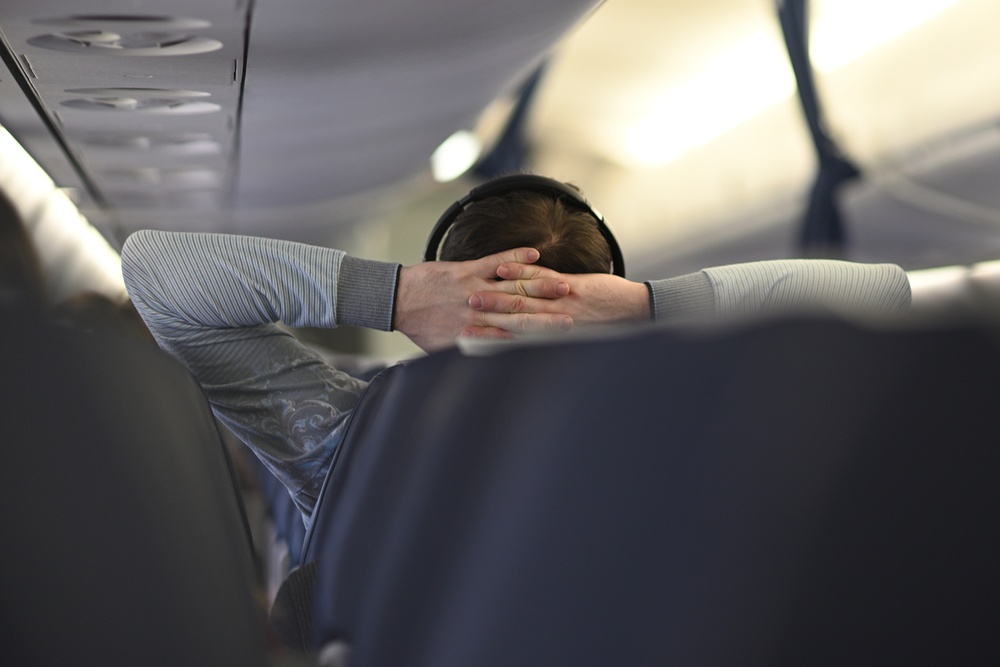

You know the sound before you even look up. A tinny, auto-played video reel bleeding out of a phone speaker at full volume. Yours. The person two rows up. The guy who just sat down next to you at the gate. You’re already wearing your own headphones, and you can still hear every word. If you’ve spent any time on a flight in the last few years, you’ve lived this moment, probably more than once. What you might not know is that one major U.S. carrier has decided it’s had enough of it, and has now put real teeth behind the request to put your headphones in.
United Airlines quietly rewrote the rules in February 2026, and the change is more significant than it first appears. This isn’t a polite cabin announcement or a strongly worded suggestion tucked in a travel app. The airline put the headphone requirement where it counts: in the legally binding document that governs what passengers must do to stay on the plane. Most people never read that document. That’s starting to seem like a mistake. Because if they don’t know what “beat pulsing” is, they might get in trouble or get kicked off the plane.
What the Rule Actually Says
The Chicago-based airline quietly added the new policy in a February 27, 2026 update to its “Contract of Carriage” document, which outlines the terms and conditions both the airline and passengers are expected to follow while traveling. The contract of carriage is the fine print you technically agree to the moment you buy a ticket.
United confirmed to Fox Business that it updated its Contract of Carriage to add headphone language under Rule 21, the airline’s “Refusal of Transport” section, giving the carrier authority to deny boarding or remove passengers who fail to use headphones while listening to audio or video content. The new language places the headphone requirement alongside other behaviors that can result in removal, including refusal to follow crew instructions and disruptive conduct.
The requirement applies broadly. It covers any sound from personal electronic devices, including music, videos, social media clips, games, and video calls, whether live or recorded. So yes, that means the FaceTime call on speaker in the middle of boarding, the YouTube video with the auto-play ads, and the Instagram reel someone is scrolling at full volume while the plane taxis. All of it.
The carrier may “refuse transport, on a permanent basis,” to any passengers who “fail to use headphones while listening to audio or video content,” according to the airline’s new rules. A permanent ban. For not wearing headphones. That’s the harshest consequence possible, though in practice, enforcement is expected to follow a more graduated approach.
United Airlines is currently the only U.S. airline with this rule written directly into its contract of carriage. While Southwest Airlines mentions headphone use on its website, the requirement is not included in its official passenger contract.
The easiest way to put it: If you listen to a video or music without headphones, you are considered “beat pulsing” and could be removed from the plane.
Why United Did This Now
The timing isn’t accidental. A United spokesperson told Fox Business: “The Contract of Carriage was updated Feb. 27 to add the headphone language. We’ve always encouraged customers to use headphones when listening to audio content, and our Wi-Fi rules already remind customers to use headphones. With the expansion of Starlink, it seemed like a good time to make that even clearer by adding it to the contract of carriage.”
That Starlink detail matters. As United rolls out faster satellite-based internet across its fleet, passengers can stream higher-quality content for longer stretches, which means the baseline volume of audio coming from personal devices is only going up. The airline is essentially getting ahead of a problem that better connectivity was going to make worse.
Because this language sits inside the airline’s “Refusal of Transport” section, it carries more weight than a polite announcement. It is now part of the binding terms passengers agree to when they buy a ticket. If a passenger insists on blasting a phone or tablet speaker after being told to stop, United has written itself clearer leverage to end the argument. Before February 2026, enforcement often depended on individual crew discretion, and some travelers recall being told that headphones were “a courtesy, not a rule” while others encountered strict interpretations where flight attendants quickly intervened.
What Happens If You Forget Your Headphones
Before anyone spirals into pre-flight anxiety about losing their earbuds in the Uber on the way to the airport, there’s a practical safety net. United’s stated approach is for crews to issue warnings and offer free basic earbuds to passengers who forget theirs, escalating only if a passenger refuses to comply. Forgetting your headphones is a fixable problem. Refusing to put them in is a different category of issue entirely.
Despite dramatic headlines, the new language does not mean every traveler without earbuds will automatically be turned away at the gate. Instead, the policy gives United explicit authority to act when a passenger insists on playing audio through speakers and refuses to comply with crew instructions to stop or plug in headphones.
That gap matters. The rule isn’t designed to catch absent-minded travelers. It’s designed to give flight attendants something concrete to point to when a passenger is knowingly ignoring repeated requests. As anyone who’s tried to politely ask a seatmate to turn down their phone can tell you, “it’s just a courtesy” carries a lot less weight than “it’s in the contract you agreed to.” When a conflict over device audio becomes a standoff, gate agents and cabin crews can point to a specific contract clause rather than relying on discretionary cabin announcements. That can speed up the decision to deny boarding before pushback, or to remove a passenger if they refuse to comply after warnings.
For families traveling with young children who rely on tablets for entertainment, the policy may require some advance preparation, especially when flying with children. Child-sized headphones, volume-limiting headsets, or pre-downloaded shows with captions can help avoid last-minute conflicts at 35,000 feet and keep screens from becoming a flashpoint in crowded cabins.
Cabin Behavior: The Broader Context
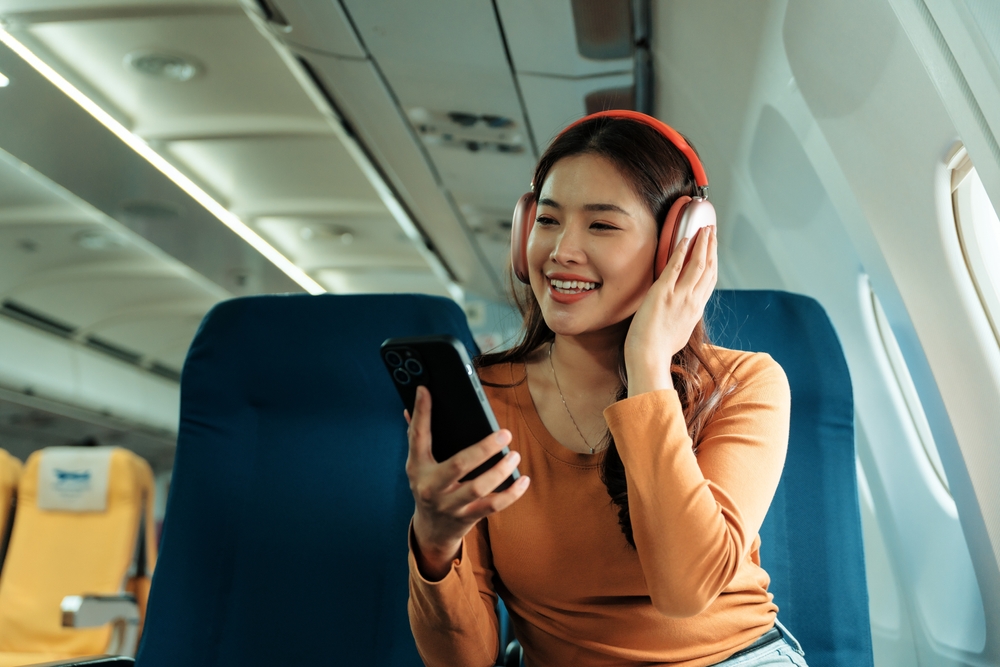
United’s new rule lands in a context that’s worth understanding. Disruptive passenger incidents hit a record high in 2021, and while the numbers have come down significantly since then, the problem hasn’t gone away. 2024 was a difficult year for airlines, as they faced well over 1,000 unruly passenger incidents. According to the FAA, airlines reported over 2,102 cases of unruly passengers in 2024, up 1% from 2023, where 2,076 were reported.
Playing loud audio through a phone speaker may seem trivial compared to the more serious incidents in that database, and technically it is. But it contributes to the same broader pattern of passengers treating a shared cabin as though it’s their own living room. As more passengers stream continuously, the frequency of “audio leakage” incidents rises, and airlines tend to formalize rules when informal norms stop working at scale. Whether United applies this aggressively or rarely, the existence of the clause signals the direction of travel: carriers are turning courtesy into enforceable conditions when the behavior reliably degrades the cabin experience for everyone else.
Some observers caution that stricter behavior policies can raise questions about consistency and fairness in enforcement. Scenarios involving cultural differences, disabilities, or language barriers may require careful handling by airline staff to avoid escalating minor issues into major disruptions. Those are real concerns, and they don’t disappear just because the rule is now written down.
For a fuller look at how flight attendants think about cabin behavior and passenger dynamics, the 21 flight attendant secrets piece gives a useful window into what crews are actually navigating on any given flight.
Why Your Headphones Are Doing More Work Than You Think
There’s a reason noise-canceling headphones have become almost universal among frequent flyers, and it goes well beyond drowning out the person watching loud videos nearby. The science on what ambient cabin noise does to the human body is genuinely interesting.
One of the most significant and least-discussed effects of aircraft cabin noise is fatigue. The human nervous system processes ambient noise even when the conscious mind isn’t focusing on it. Background noise at 80-plus decibels keeps the nervous system in a state of low-level activation, a mild but continuous stress response that depletes cognitive and physical energy over time. This is why passengers often feel disproportionately exhausted after long flights, even when they slept for several hours. Part of what they’re recovering from is not just the travel itself, but the sustained neurological cost of processing hours of relentless noise.
For travelers who experience flying anxiety, a condition affecting an estimated 25% of the flying public to some degree, cabin noise is a significant stressor. According to Airlinetraveler.com, the relentless roar of engines can be interpreted by an anxious nervous system as a warning signal, keeping the body in a state of hypervigilance and making relaxation nearly impossible. The acoustic quieting effect of noise-canceling headphones has a measurable calming influence on anxious flyers. By removing the primary sensory trigger of the engine noise, the technology helps break the cycle of environmental hypervigilance that drives flight anxiety.
So when United says the policy aims to deliver “quieter flights,” a quieter cabin is a demonstrably less stressful cabin, for everyone on board.
The Quiet Part Out Loud
Having a rule on paper and actually applying it consistently are two entirely different things, and anyone who flies regularly knows that inconsistency is baked into the airline experience. The same behavior that gets one passenger removed on one flight might get a shrug on another, depending on who’s working the cabin and how busy the boarding process is. Enforcement is the real question, and it’s an honest one.
What the contract change does accomplish is something structural. It moves the burden off individual passengers trying to police each other. Instead of an awkward confrontation between seatmates, where asking someone to turn their phone down becomes a standoff, the crew can step in with an objective standard behind them. That matters for flight attendants who’ve been navigating these situations on goodwill alone, and it’s probably a relief for the rest of the cabin too.
The rule also sends a signal to the broader industry. United is the first major U.S. carrier to embed this requirement in formal contract language. Whether others follow will likely depend on how enforcement plays out and whether passengers push back in meaningful numbers. For now, the message is clear enough: the era of treating a plane cabin as a private screening room is, at least on United, officially over. Pack your headphones. Or be ready to accept a pair of free ones and comply anyway.
AI Disclaimer: This article was created with the assistance of AI tools and reviewed by a human editor.