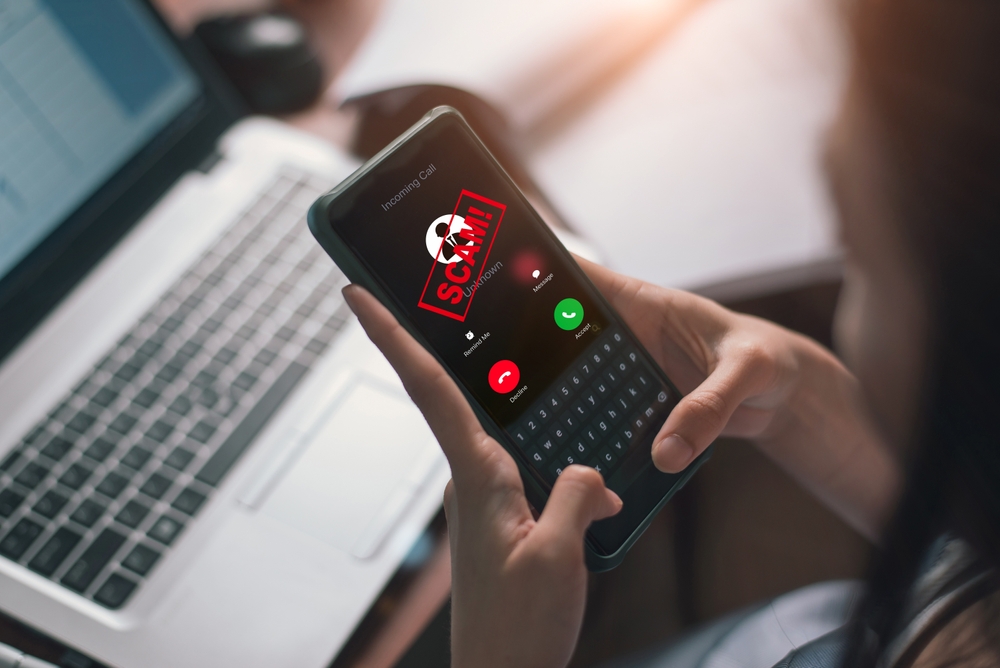

It’s a familiar, frustrating experience: your phone rings, you answer, and you’re met with dead silence. It’s easy to dismiss this as a simple misdial or a network glitch, but the truth is far more concerning. That silent call isn’t an accident; it’s a calculated first move in a sophisticated fraud operation designed to identify and profile potential victims.
Scammers use automated dialing technology to blast out thousands of calls at once. Their initial goal is simple: to find out which phone numbers are active. When you pick up, you unknowingly confirm that your line is live, instantly making your number more valuable and marking you as a responsive target for future scam attempts.
The risk, however, goes beyond just getting more calls. In the most advanced schemes, that silent moment is designed to capture a sample of your voice. Just by saying a simple “hello,” you could be handing scammers the raw material they need for AI-powered impersonation scams, where they can convincingly use your voice to trick your loved ones. This tactic is a key part of a massive criminal industry, with financial losses for victims climbing higher every year.
The Anatomy of a Silent Call
The silent call scam is not random. It is a deliberate test. Scammers use automated systems to dial thousands of numbers at once and wait to see who answers. When you pick up, you confirm that your number is active and monitored by a real person. Once your number is flagged as “live,” it becomes more valuable and may be sold or reused for future scams.
The operational infrastructure behind this is well-documented. Most silent call attempts are powered by robocall systems and predictive dialers, systems that call multiple numbers at once and only connect to a live agent if one is available. If you answer and hear a short delay before someone speaks, it is usually an automated system “handing off” the call to a live person once it hears your voice. In cases where no agent is available, the line simply goes silent, and the system still logs the pickup as confirmation that the number belongs to an active, responsive user.
Identity criminals call this “automated reconnaissance.” It is a way for them to verify your number before they waste time on a human-led scam. The economics of the approach are efficient by design: rather than paying a human agent to cold-call thousands of dead numbers, automated dialers sweep through large lists and flag only those numbers that produce a human response.
Why Caller ID Cannot Be Trusted
Not all silent calls come from unknown or hidden numbers. The caller ID feature should not be trusted, as criminals can easily abuse it. If the caller ID says it’s a call from a bank or some other organization, it doesn’t mean it’s true. Scammers often use caller ID spoofing to make their calls appear legitimate so that you are more likely to answer. This practice, spoofing a local number, a known institution, or even a family member’s number, is designed to bypass the first line of defense most people rely on: checking whether the number looks familiar before picking up.
What Happens After You Answer
Answering a silent call sets off a sequence that most recipients never anticipate. Once your number is confirmed as active, it can be sold to other scammers or used for more serious attacks, like trying to take over your accounts or your phone service. As the scammer’s system flags your number as “active,” it is added to a scam database or sold to fraud networks. Scammers want to build a verified list of real phone numbers for future scams, or to resell your number to robocallers, phishing scammers, and AI-powered fraudsters.
It may seem harmless, but it can trigger a chain reaction. Once your number is confirmed, it may be added to scam call databases used for phishing or identity theft. You could start receiving more aggressive calls pretending to be from banks, Medicare, or Social Security. Some scams escalate quickly, using urgency or fear to pressure you into giving personal information.
Silence feels safe. A call without conversation seems benign, leading victims to lower their guard. It’s also a perfect way for criminals to bypass suspicion: no threats, no persuasion, no giveaway accents. The psychological design is deliberate. A silent call does not trip the internal alarm that a demanding or aggressive caller would. Most people chalk it up to a wrong number and move on, not realizing that their phone number has just been upgraded from an uncertain data point to a confirmed asset.
The “Quiet Game” Phenomenon
That short pause before someone finally speaks is the “handoff.” An automated system is dialing thousands of numbers at once, and the moment it hears your voice, it connects the call to a live person. This is why many people report that calls they assumed were technical glitches were, in fact, functioning exactly as designed. The brief silence is not a dropped call. It is a computational transaction, completing in the fraction of a second between your voice registering and the system routing you to a human operator.
Fraud investigations have revealed that many scams now use a hybrid approach: an AI voice bot places thousands of calls efficiently, the bot listens and responds dynamically to screen for more trusting or compliant targets, and once a victim is engaged, the call is transferred to a live scammer who finishes the fraud.
The “Say Yes” and Voice-Harvesting Risk
The “Can You Hear Me?” Scam
A closely related and extensively documented variant of the silent call is the “say yes” or “can you hear me?” scam. The four-word phone scam involves a recorded voice that asks, “Can you hear me?” when the victim answers the call. The phrase is designed to trick the victim into responding “yes,” while the person or computer on the other end records. The scammer can then use the recording to access the victim’s accounts, when asked to authorize log-ins, make a major purchase, or sign up for expensive services, the scammer impersonates the victim with the recorded “yes.”
In a worst-case scenario, scammers may use a recording of you saying “yes” to authorize charges on your phone. This is known as a cramming scam, where a bad actor “crams” unauthorized service charges onto your bills once they have your information.
The risk, however, carries an important qualification. While AI voice cloning is a concern, saying a quick “hello” is usually not enough for a scammer to steal your voice. Amy Nofziger, the director of victim support for the AARP Fraud Watch Network, said that the “can you hear me?” question on its own does not warrant significant panic. She stressed that there has been no evidence from AARP databases tying a response to the question to cramming or monetary fraud. The caution is warranted and proportionate: the risk is real but should not be treated as catastrophic from a single word. Experts say scammers can record short audio clips if you speak, which may be used in more advanced scams. However, claims that a simple “yes” can instantly clone your voice are often overstated. Still, even limited recordings can help scammers build more convincing impersonation attempts. That’s why minimizing interaction is always the safest approach.
The Escalating Threat of AI Voice Cloning
Where the risk becomes considerably more serious is in the AI voice cloning context, a distinct but increasingly convergent threat. Modern AI voice synthesis tools, several available free online, can generate a convincing voice model from as little as 3 seconds of audio. The source does not need to be high quality. A clip from a TikTok video, a voicemail greeting, a YouTube comment, or an Instagram story, any public audio of someone speaking is sufficient.
AI-powered voice phishing attacks resulted in $5 million in losses in 2025 alone. Globally, scams of all kinds resulted in an estimated $442 billion in losses in 2024, and the trend is accelerating.
The human cost of these attacks is not abstract. In July 2025, Sharon Brightwell of Dover, Florida, received a call that no parent wants to hear. Her “daughter,” crying and distraught, claimed she had been in a car accident, had lost her unborn child, and was in legal trouble. The voice pleaded for immediate financial help to prevent criminal charges. Overwhelmed by emotion, Brightwell sent $15,000 in cash to a courier. Only after speaking to her real daughter did she realize the deception. She had not heard her daughter’s voice on the phone. She was listening to an imitation of her daughter’s voice artificially generated using AI voice cloning technology, a case documented by local Florida news outlets covering the rise of grandparent and family impersonation scams.
The FTC and AARP consistently document that people over 60 are disproportionately targeted by virtual kidnapping and AI voice scams. The reasons are direct: older adults are statistically more likely to answer unknown numbers, may be less familiar with voice synthesis technology, and often have grandchildren active on public social media providing the audio source.
Current Federal Activity
The number of consumer complaints about illegal telemarketing robocalls steadily decreased from FY 2017 through FY 2024. While the number of complaints about robocalls ticked up in FY 2025, reports remain substantially lower than their peak in FY 2017.
In FY 2025, more than 4.7 million additional phone numbers were added to the National Do Not Call Registry, bringing the total to about 258.5 million active registrations as of September 30, 2025. While registrations grew modestly, complaints about robocalls continued to make up most DNC violation complaints.
The FCC and all 50 states are getting more aggressive in trying to crack down on robocalls. The FCC essentially shut down about 1,400 phone companies in August 2025 that were accused of allowing illegal calls. States, meanwhile, are on offense with their “Operation Robocall Roundup.” In December, the attorneys general in all 50 states plus Washington, D.C., sent high-stakes letters to four prominent phone companies: Lumen, Peerless, Bandwidth, and Inteliquent.
The Compliance Gap
Despite legislative and enforcement action, analysis by the U.S. PIRG Education Fund found that of 9,242 phone companies that filed with the FCC as of September 2025, 4,084 had completely installed the required robocall-fighting software, down from 4,365 the previous year. Only 44% of phone companies have completely installed the mandated software and adopted anti-robocall policies, down from 47% in 2024. That compliance gap is significant: more than half of the country’s phone carriers are operating without the full technical infrastructure required by federal law to authenticate incoming calls.
Call-protection company YouMail’s Robocall Index estimates that Americans still receive around 4 billion robocalls every month, including 3.8 billion in November 2025 alone. Their data shows that in that month, about 56% of those calls, roughly 2.2 billion, were unwanted scam or telemarketing traffic.
Because analytics tools can’t categorize calls with no audio, all those silent and super-short calls don’t even fully show up in the robocall statistics. They’re the uncounted ghosts in the machine.
Consumer Defense: A Tiered Protocol – Immediate Call Handling
If you answer a call and hear silence, your response matters. Stay silent. Don’t say anything, even “hello,” if you suspect a silent call scam. The sooner you disconnect, the less useful your number becomes.
If you feel like you need to pick up an unknown number, try not saying anything at all. If the computer on the other end doesn’t hear a voice, it might think your number is dead and take you off the list. If you don’t recognize a number, it’s best not to answer. Legitimate callers, like banks, service providers, or businesses, will leave a message or reach out via official channels.
If you do end up answering and the caller is asking you a question right away, avoid saying “yes.” Instead, give a question back to them, asking something like “Who am I speaking to?” or “What is the purpose of your call?” Questioning the caller may cause them to hang up, ensuring you avoid saying the word “yes” at all.
Technical and Platform-Level Defenses
Most major carriers, including Verizon, AT&T, and T-Mobile, have free tools to block spam calls. Apps like Hiya or RoboKiller can do the heavy lifting automatically. Most modern smartphones have built-in call-blocking tools that can automatically silence calls from unknown numbers. Third-party apps like Truecaller or GetContact can also identify and block scam calls.
Silent or ultra-short calls can be reported at DoNotCall.gov, and those complaints feed directly into the analytics used to spot and disrupt illegal campaigns. Consider changing your voicemail greeting to avoid revealing personal information. Using the automated message your phone provides, such as “[your number] is not available. At the tone, please record your message,” or creating a simple greeting with just your first name if absolutely necessary makes it harder for scammers to personalize attacks.
Protecting Against AI Voice Cloning

The Federal Bureau of Investigation and the FTC suggest that the most effective defense against AI voice scams is a “challenge and response” system. Creating and sharing a secret word or phrase with family members, including parents, grandparents, and children, and requesting that the password be used only by family members provides a verification layer. Setting up personal security questions that are only answerable by family members and cannot be found through social media or internet searches adds further protection.
The FTC is unambiguous: no legitimate emergency, not police, not hospitals, not bail bondsmen, not any government agency, will ever request payment via gift card or wire transfer. This is the universal scam payment signature. If any call, no matter how convincing, directs you toward gift cards as a payment method, the call is a scam.
Scammers typically research families on social media, looking for videos that contain a family member’s voice, then use AI tools to replicate that voice using their own script, according to an FBI alert. Limiting the public availability of audio on social media accounts, particularly for older family members whose voices may appear in grandchildren’s publicly posted videos, directly reduces the raw material scammers need to build a convincing clone.
Credit and Account Security
The most important thing you can do for your overall security beyond call handling is to freeze your credit. It is the single best way to make sure a criminal can’t open new accounts in your name, even if they have your number. Using passkeys when available, or at minimum long, unique passphrases with multi-factor authentication, the extra code sent to your phone or verification app, keeps accounts locked down.
Key Takeaways
1. The silence is the scam. A silent call is not a technical error. It is an automated probe confirming that your number is active and that a real person answers it. That information has monetary value in criminal markets.
2. Answering confirms your number as “live.” When you answer, you confirm that it’s an active phone, and your number can be added to lists sold on the dark web or reused in voice-phishing, SMS scams, or AI voice-cloning attacks.
3. The “say yes” risk is real but calibrated. Saying “yes” or “hello” on an unknown call carries genuine risk, primarily as a voice sample and as confirmation of an active number, but claims that a single word enables immediate account takeover are overstated. The risk compounds over time and escalates if the scammer gathers more detailed audio.
4. AI voice cloning is a present threat, not a future one. In 2025, the FBI issued a public alert warning that criminals were using AI-cloned voices to impersonate senior U.S. government officials. The technology is available, inexpensive, and requires only seconds of audio to produce convincing results.
5. The regulatory environment is improving but incomplete. Federal enforcement has shut down over a thousand non-compliant carriers, and Do Not Call registrations now total over 258 million numbers. But more than half of US carriers still lack full anti-robocall authentication infrastructure, and silent calls are largely invisible to existing analytics systems.
6. The most effective immediate defenses are behavioral. Let unknown calls go to voicemail. Stay silent or hang up immediately if a call opens with silence. Never provide a verbal “yes” to unsolicited callers. Establish a family safe word for use in any emergency-sounding call. Register at DoNotCall.gov and report silent calls when they occur.
7. Platform-level tools are free and effective. The National Do Not Call Registry is a list of landline and wireless phone numbers that legitimate telemarketers agree not to call. Numbers can be registered for free at donotcall.gov, or by calling 1-888-382-1222. Major carriers also offer no-cost call-filtering services that can intercept a significant portion of automated scam traffic before it reaches the consumer.
If you believe you have been targeted by a phone scam or are experiencing an escalating pattern of suspicious calls, the FTC’s ReportFraud portal accepts consumer complaints and uses that data to build enforcement cases against illegal callers. For anyone who has already responded to a suspicious call and shared personal or financial information, the Identity Theft Resource Center offers free live-advisor support at 888-400-5530.
What To Do With All of This
Here is the frustrating truth at the center of all of this: you can follow every piece of advice in this article, freeze your credit, establish a family safe word, never say “yes” to an unknown caller, and still find yourself on the receiving end of a wave of targeted calls. The systems generating these calls are automated, indifferent, and cheaper to run than almost any other form of fraud. Your phone number is worth something on criminal markets precisely because someone confirmed it was active, perhaps years before you read this. That’s not a reason to despair. It is a reason to be clear-eyed about what protection actually looks like, which is less about perfection and more about making yourself a harder target than the next person on the list.
The behavioral steps matter most, and they are also the easiest to actually implement. Let the unknown calls go to voicemail. Set up that family safe word tonight, even if it feels slightly absurd over dinner. Report the silent calls at DoNotCall.gov so the complaint data keeps feeding enforcement. And if an elderly parent or grandparent in your life still answers every call on the first ring because that’s just what you do, have the honest conversation with them. Not to frighten them, but because the scammer on the other end of the next call is absolutely counting on the fact that no one did.
AI Disclaimer: This article was created with the assistance of AI tools and reviewed by a human editor.