
The Democratic Party hasn’t been in this position in decades. No incumbent on the ballot. No obvious heir. No vice president waiting in the wings. The 2028 presidential race is an open field, and the jockeying started almost before the 2024 results were fully called. Governors are building national PACs. Senators are making sure everyone knows their name. Former cabinet members are telling audiences to save them a seat. Nobody has officially announced anything, but the shadow primary is already running at full speed.
What’s driving the intensity isn’t just ambition. The party lost the White House in 2024 after a late candidate switch and a brutal general election campaign, and the question of where Democrats go from here is genuinely unresolved. There’s no consensus. No heir. No obvious move. That’s unsettling for party operatives, but it also means this primary could go a lot of different ways.
Below are seven candidates who have the most credible claim to the nomination right now, each representing a different idea about what the Democratic Party should be and who can actually win.
1. Gavin Newsom
Newsom has been the clearest signal in a field full of noise. He told CBS News Sunday Morning that after the 2026 midterms he would give serious thought to a run, adding, “Yeah, I’d be lying otherwise.” He’s been building toward it in the most visible way possible: hosting debates, staying on cable news, and positioning himself as the loudest Democratic voice against the Trump administration.
When one survey asked voters which candidate was most likely to win the 2028 general election if they were the Democratic nominee, Newsom came in first at 28%, with Harris second at 19%. That electability edge matters. He’s also built a leadership PAC with nearly $4 million ready to deploy for fellow Democrats in this year’s midterms, which is the classic move of someone who wants favors returned later.
The headwind is just as clear. Within the Democratic field, surveys in 2026 showed Harris leading overall in many polls, with Newsom and Ocasio-Cortez both drawing significant support; the Echelon Insights April 2026 poll surveyed 1,012 voters in the likely electorate from April 17 to April 20, with a 3.5 percent margin of error. California’s fiscal problems are real, and Republicans will use them. Whether voters outside the West Coast see him as a national leader or a coastal brand remains the central question.
2. Alexandria Ocasio-Cortez
AOC has served as New York’s 14th congressional district representative since 2019, and she dominates among young voters in a way no other candidate currently does. A May 2026 AtlasIntel poll placed her at the top of the Democratic primary field with 26% support, drawing twice as many votes as Kamala Harris.
When David Axelrod directly asked her about 2028 in Chicago, she said she does not want to make decisions as a lawmaker with the idea of one day becoming a senator or president weighing in the back of her mind, adding, “My ambition is to change this country.” That’s not a no. Her challenge is the general election. Democrats who want to win back working-class voters in Pennsylvania and Michigan are nervous about running a progressive New Yorker at the top of the ticket. If she runs for Senate instead, she reshapes the primary entirely.
3. Pete Buttigieg
Pete Buttigieg ran for president in 2020, became Transportation Secretary under Biden, and is now the one potential candidate who seems to have made a decision without announcing it. At a recent gathering of Democratic figures, Buttigieg told the crowd, “You save me a seat, I’ll be there.” He had previously decided against running for Senate in Michigan, a move that opened up considerable speculation about a presidential run.
Harris told Laura Kuenssberg in an October 2025 BBC interview that she is “not done,” while in November 2025, Morning Consult reported that she remained atop its hypothetical Democratic primary field; by February 2026, polls suggested she would win a rematch with Trump, though she said in a podcast interview that same month she had not decided on running again.
Buttigieg’s case is that he’s already run a national campaign, knows the mechanics, and has built genuine support in communities – particularly the Midwest – that Democrats need to win back. The case against is 2020: he struggled badly with Black voters in the primary and never fully resolved that problem. Democratic strategists know that winning without building a genuine coalition with Black voters is nearly impossible. That’s the work he needs to show he’s done.
4. Kamala Harris
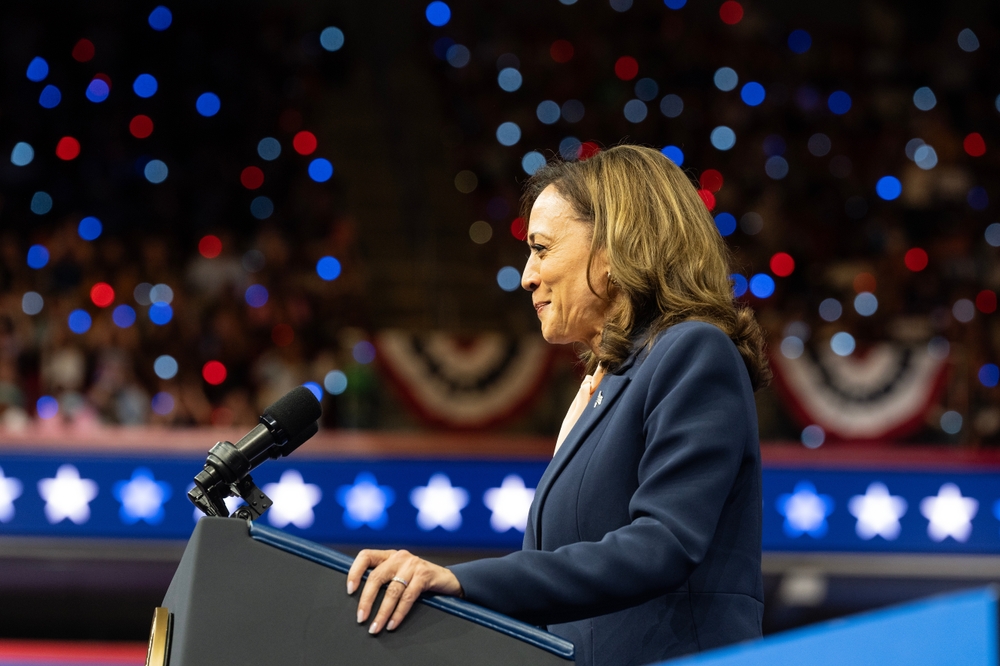
Harris is the most complicated figure in this field. Her name recognition keeps her near the top of primary polls, but party insiders are skeptical. The 2024 loss was recent and painful, and a rematch carries obvious risks.
Early 2026 polls showed Harris leading the Democratic primary field in many national surveys. The complicated reality is that those numbers may reflect familiarity more than enthusiasm. As Columbia University professor Robert Y. Shapiro told Newsweek, “Her advantage for now is name recognition.” Surveys across 2026 showed her leading overall in many samples, with Newsom and Ocasio-Cortez both drawing significant support behind her. Whether primary voters are genuinely enthusiastic about her, or simply default to her name in early polls, is a distinction the next eighteen months will settle.
5. JB Pritzker
The Illinois governor is a quieter name in national conversation, but he’s been building toward this for years. Like Newsom, Pritzker was on Harris’s vice presidential shortlist and has not ruled out national ambitions. After Trump called for him to be jailed last fall, the governor made headlines with his response: “Come and get me.”
Pritzker has used his personal wealth to finance both his own political career and a host of other Democrats. He praised Democrats’ 2028 bench without rejecting a run of his own, saying he was committed to being “more involved than ever before” in 2028 while running for reelection as governor this fall. His path to the nomination runs through money, organization, and the argument that a governor who has actually managed a large state is better prepared than a congressman or senator. His ceiling in early polling is modest, but his floor – financial resources, national network, anti-Trump credibility – is high.
6. Andy Beshear
If Democrats lose 2028 because they couldn’t win a single swing state, Andy Beshear will be the name people recall as the road not taken. The Kentucky governor is a moderate Democrat who has demonstrated the rare ability to win statewide in deep-red territory. He won the governorship in 2019, then beat back a Trump-backed challenger to win reelection, and his approval ratings have remained among the highest of any governor in the country.
In a recent interview, Beshear said he is “comfortable” being named as a potential 2028 contender, and that he will not make a final decision until his term as chair of the Democratic Governors Association ends. “But I certainly at least want that conversation that’s out there to be one that’s focused, to where whoever is the nominee can win,” he said. “This election for Democrats isn’t a need to win; it’s an absolute have to win.”
His polling numbers remain modest for now, largely because he’s not yet widely known nationally. Name recognition at this stage of a pre-primary cycle is mostly a function of time and exposure, and the argument that he can win where other Democrats can’t is exactly what a party desperate to recapture working-class voters needs to hear. His travel tells the story of a man considering his own path – he is set to visit New Hampshire and South Carolina, two early-primary states that anchor the presidential nominating calendar.
7. Cory Booker
No one in this field had a more striking moment in the first half of 2025 than Cory Booker. From March 31 to April 1, 2025, Booker delivered the longest recorded speech in United States Senate history while protesting the second presidency of Donald Trump and the operations of Elon Musk’s Department of Government Efficiency, beginning at 7 p.m. EDT on March 31 and lasting 25 hours and 5 minutes, surpassing Strom Thurmond’s previous record. GOP pollster Frank Luntz remarked the speech positioned Booker as a party leader for the future.
In a March 2026 interview on CBS News Sunday Morning, Booker indicated he was “considering” a run for president in 2028, saying it was a fifty-fifty chance he would run.
His challenge is structural. Senators historically have a harder time winning presidential primaries than governors do, partly because governing a state gives candidates a concrete record of executive action to run on. Booker’s marathon speech gave him a defining moment, but a defining moment and a campaign are different things. If he can translate that visibility into a credible organizational presence in Iowa, New Hampshire, and South Carolina before the field consolidates, he’s a real factor. If he waits too long, the governors in this race will have already lapped him.
What the Numbers Actually Tell Us
Early polls two years before a primary are mostly a measure of name recognition, not momentum. Political science professor D. Stephen Voss at the University of Kentucky put it plainly in an interview with Newsweek: polls this far out reflect who people have already heard of, not who they’ll actually vote for. Frontrunners collapse fast, newcomers rise once voters get to know them, and even a year from now the numbers may not be predictive.
What the polls do tell us is something about the shape of the race. The current top tier – Newsom, Ocasio-Cortez, Buttigieg – each represent a genuinely different theory of the Democratic Party. Newsom is the executive argument: big state, national profile, tested in combat with the Trump administration. AOC is the generational argument: the party needs to stop running from its young voters and start running toward them. Buttigieg is the reassurance argument: smart, already campaigned nationally, and much of the party knows what they’d be getting.
Below that tier, the candidates making the electability case – Beshear in particular – may matter most after the field narrows. The party has lost the last two times it ran the candidate it was excited about rather than the candidate who could win the specific map required by the Electoral College. That lesson is sitting somewhere in every conversation happening in Democratic back rooms right now, even when nobody says it out loud. Whether primary voters actually act on it remains, as always, the hardest question in American politics.
The honest answer is that none of this gets resolved until actual votes are cast. Between now and then, there will be midterm results to interpret, debate stages to dominate, and a dozen moments that reshape the race in ways nobody can currently predict. The shadow primary is already running. It just hasn’t turned the lights on yet.
AI Disclaimer: This article was created with the assistance of AI tools and reviewed by a human editor.