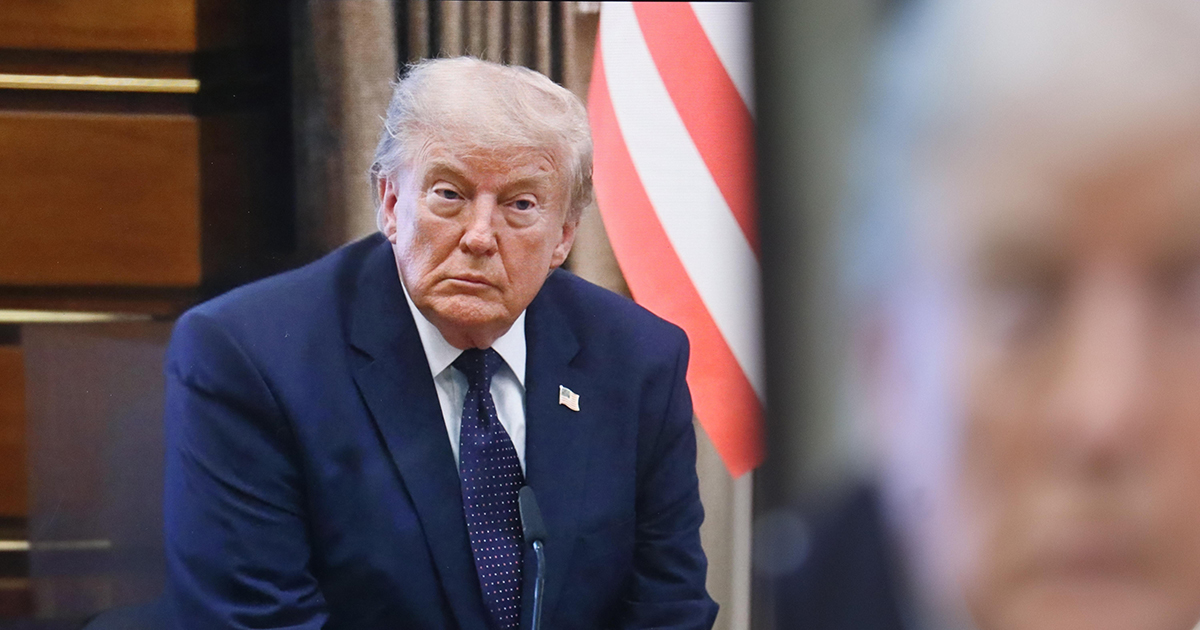

Seated in the front row of the packed Washington National Cathedral, Donald Trump appeared at times to be on the verge of nodding off. He had just given a eulogy. He had patted the casket on his way back to his seat. And then, cameras still rolling, his eyes closed and stayed that way.
The moment landed on social media within minutes. By Tuesday evening, the clip had become one of the most-watched videos on X.
Graham, an influential Republican and outspoken foreign policy hawk, had died unexpectedly earlier this month of an aortic rupture. The service at Washington National Cathedral was a state occasion that demanded presence and attentiveness.
The Funeral Itself
Graham died at the age of 71 from a tear in his aorta, or aortic dissection, according to a preliminary finding from the Washington, D.C., medical examiner. An acute aortic dissection is a medical emergency in which a tear develops in the inner layer of the body’s main artery. The condition can rapidly become fatal if blood forces its way between the layers of the aorta and causes the vessel to rupture.
The first day of services began at the U.S. Capitol, honoring Graham’s military and political career. An Armed Forces Body Bearer Team carried his remains into the Capitol to mark his service in the Air Force. Following the Rotunda ceremony, his remains were taken to Washington National Cathedral for a funeral service starting at 2 p.m.
Graham’s funeral drew TV personalities, top lawmakers, and foreign heads of state, including Israeli Prime Minister Benjamin Netanyahu and Ukrainian President Volodymyr Zelenskyy. Senate Majority Leader John Thune called Graham “a towering figure,” adding that there was “no one more capable of cracking up a room.”
Trump’s Eulogy: Off-Script From the Start
Before the cameras caught Trump with his eyes closed, they had already caught him departing from his prepared remarks.
The New Republic reports that Trump veered off course during his eulogy at the Washington National Cathedral, recalling the time he publicized Graham’s personal cell phone number during a heated moment in the 2016 presidential race. Trump acknowledged the two had a rocky start when they were both running for the Republican nomination, before describing how the episode eventually gave way to a decade-long friendship.
Trump recited the number again from the pulpit, saying “And I remember the number (202) 228-0292 if anybody wants to give it a shot.” The comment earned laughter from the church.
Trump also veered off course while recalling Graham’s life, pushing back on one detail: Graham’s popularity. “Virtually everyone, Republican or Democrat, liked Lindsey,” Trump said, before jumping from his script. “I have to veer from this for a second,” Trump announced, before continuing with his own assessment that Graham was, in fact, not universally beloved. Moments after concluding his remarks, Trump walked over and tapped on Graham’s coffin on his way back to his seat.
The Eyes Closed, the Cameras Rolling
The 80-year-old president looked to be struggling to keep his eyes open, despite having delivered remarks just moments before. Trump’s eyes remained closed as his posture seemed to slacken during Tuesday’s funeral service.
Journalist Aaron Rupar, who circulated a clip from the service, wrote that Trump’s face appeared to be “drooping heavily” as he struggled to stay awake. The short video quickly escaped the solemn boundaries of the cathedral and became another debate about Trump’s stamina, age, and fitness for office.
To some viewers, the president was simply resting his eyes during a lengthy ceremony. To others, the moment looked unmistakable: the commander in chief had fallen asleep while Washington mourned one of his longtime political allies.
The Reaction Online

Social media commenters were quick to express frustration. Users pointed out that Trump had repeatedly accused Joe Biden, his Democratic predecessor, of falling asleep on the job, nicknaming him “Sleepy Joe.”
One user wrote that it was the “sweet irony of Trump falling asleep.” Another noted that if Biden had slept through a friend’s funeral, the story would still be running years later. One X user wrote: “Yes everyone, this is the man that holds the nuclear codes. Let that sink in.”
Some users came to the president’s defense, with one commenter writing: “Pretty easy to fall asleep in church.” That response got its own wave of replies, most of them pointing out that the circumstance was somewhat different from a drowsy Sunday service.
As Trump left the funeral, the debate was no longer only about whether he had fallen asleep. It was about why so many Americans were ready to believe that he had.
The Bigger Picture: An 80-Year-Old President Under Scrutiny
Trump turned 80 this year, and scrutiny over his age has intensified steadily. He remains the oldest inaugurated U.S. president in history. The White House has pushed back consistently on any suggestion of diminished capacity.
According to STAT News, Trump’s physician Sean Barbabella stated in a memo that Trump “remains in exceptional health, exhibiting strong cardiovascular, pulmonary, neurological, and physical performance.” The memo was released after a checkup at Walter Reed National Military Medical Center in October 2025.
Since taking office for a second term in January 2025, Trump has been recorded appearing to nod off during public appearances, and close-up images of his hand as recently as December showed thick patches of makeup. Trump himself raised alarm in October when he told reporters he had undergone an MRI scan, a procedure commonly used to diagnose and monitor serious conditions such as cancer, heart disease, and other disorders that affect soft tissue.
A YouGov survey found that about half of Americans say Trump is too old to be president, while 36 percent disagree. The same polling found that about half of Americans believe Trump is experiencing cognitive decline, and 36 percent say his health and age are severely limiting his ability to do the job.
The “Sleepy Joe” Problem
Trump didn’t just casually criticize Biden’s age during the 2024 campaign. He built a whole brand of attack around it. “Sleepy Joe” was on the merchandise. It was the pre-rally warm-up. It was the punchline at rally after rally for the better part of two years.
Trump still mocks his predecessor Joe Biden about his advanced age and continues to refer to him as “Sleepy Joe.” The nickname and the attacks were so consistent and so visible that the moment a video emerged of Trump, eyes closed, posture slack, at the funeral of his close ally, the callback practically wrote itself.
Political attacks based on age can reverse on their authors, and fast. The same footage that looks like fatigue to one viewer looks like a brief, inconsequential eye-close to another. The interpretation almost always follows the politics.
What This Actually Means
A person can close their eyes at a funeral for reasons that have nothing to do with sleep. The cathedral was warm. The service was long. He had just delivered a speech. People who have attended state funerals will tell you that the combination of formality, stillness, and emotional weight can produce an almost sedative effect on even the most attentive mourners.
The moment accelerates a conversation that was already happening. The debate about presidential age and fitness didn’t start with this video, and it won’t end with it. About half of Americans already say Trump is too old to be president. For those people, the footage from Washington National Cathedral isn’t a data point. It’s confirmation.
For his supporters, the same footage is a distraction from a record that includes the very presidency they voted for. They saw a man who, minutes before, stood at a podium in one of the country’s most storied cathedrals, cracked jokes, told a story about a cell phone number, and tapped his friend’s coffin on the way back to his seat. They don’t see decline. They see a person.
Cameras at state funerals are unforgiving. They catch every slackening jaw and every closed eye in a room full of dignitaries, and they make decisions about what to clip and circulate. They also can’t tell us whether the most powerful office in the world requires the full, awake presence of its holder at every moment of every ceremony. What they can do is produce footage that a politically divided country receives in completely different ways, and then argue about for the rest of the week.
Disclaimer: This information is not intended to be a substitute for professional medical advice, diagnosis, or treatment and is for information only. Always seek the advice of your physician or another qualified health provider with any questions about your medical condition and/or current medication. Do not disregard professional medical advice or delay seeking advice or treatment because of something you have read here.
AI Disclaimer: This article was created with the assistance of AI tools and reviewed by a human editor.