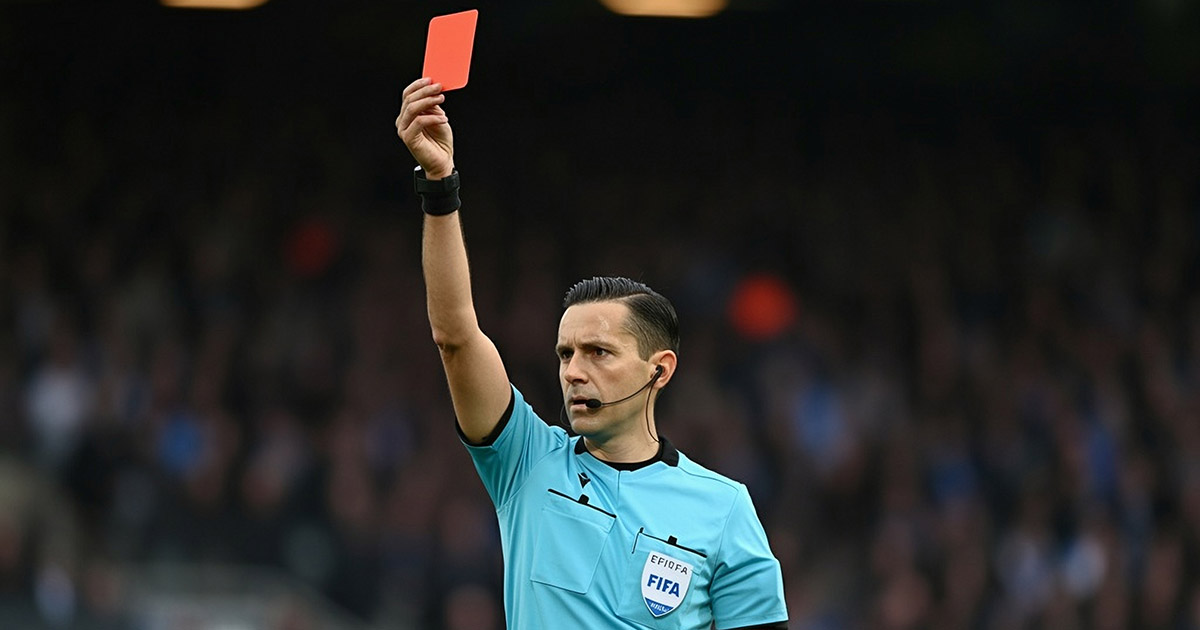

Referee Raphael Claus saw nothing worth a card in real time. The foul wasn’t called. Play continued. Then the video review officials stepped in, sent Claus to the pitchside monitor, and showed him Folarin Balogun stepping on a Bosnian defender’s ankle in slow motion. Claus sent Balogun off. And from that moment, the Balogun red card controversy stopped being just about a soccer match.
What followed over the next four days touched presidential phone calls, an emergency midnight appeal, a rule that almost nobody had heard of, and a public admission from Donald Trump that he had no idea what a red card was until his team’s top scorer was facing a suspension for one.
What Actually Happened on the Field
Balogun was sent off in the 64th minute of the U.S. match against Bosnia and Herzegovina after he stepped on the back of defender Tarik Muharemović’s ankle. He was not called for a foul in real time. Video replay officials, uncomfortable with what they saw in the replays, sent referee Claus to the pitchside monitor. By the time Claus got there, the slow-motion footage had already done its work.
Former Premier League and Championship referee Andy Davies, writing in ESPN’s VAR review column, was unambiguous: in his opinion the incident was not a red card offense, the contact was purely accidental and the result of two players challenging for possession in a normal football movement, and VAR’s recommendation to the referee was based on slow-motion and still replays, which is not aligned with VAR protocols. Those protocols specify that slow-motion footage should be used only to determine point of contact in a tackle, not to assess its intensity.
Davies added that once Claus was shown those images, “it would have been a surprise if the referee did not send off Balogun considering the pictures he was presented by VAR.” The referee made the only call the images led him toward. The decision was made before he reached the monitor, just not by him.
Balogun, the U.S.’s top scorer with three goals in the tournament, received an automatic one-game suspension alongside the red card, per Article 10.5 of FIFA’s World Cup rules. Multiple FIFA officials confirmed after the match that teams had no route to appeal either the card or the resulting ban.
Trump’s Intervention: The Call to FIFA
President Donald Trump confirmed he personally asked FIFA chief Gianni Infantino to review the decision to give a red card and one-game ban to Team USA star striker Folarin Balogun, as CNN first reported.
U.S. Commerce Secretary Howard Lutnick and Andrew Giuliani, the executive director of the White House Task Force for the World Cup, helped recruit lawyers and communicated with U.S. Soccer officials as they presented their case to FIFA to ask for Balogun’s ban to be lifted. The U.S. government provided additional evidence that was used in the appeal process, which a U.S. official noted is run by an independent board.
Trump was careful in his public framing. “All I did was ask for a review. I didn’t say, ‘You have to do this,’” he said from the Oval Office, adding that he “didn’t think it was a foul” and described the incident as “two guys running full speed that happened to crash into each other.” He also said he couldn’t tell Infantino what to do, and that an independent committee had ultimately “made the right decision.”
In December, Infantino and FIFA awarded Trump the inaugural “FIFA Peace Prize” at the World Cup draw. The president is expected to play a role in the trophy ceremony at the World Cup final on July 19.
Trump Didn’t Know What a Red Card Was
Trump admitted on Monday that he initially had no idea what a red card was or what getting one meant for a player’s availability. “I didn’t know what the hell a red card was,” Trump told reporters. While the president told reporters “I understand sports really well,” he also suggested he was unaware that a red card meant the player would be unable to compete in the next match. “I didn’t know what that meant, I didn’t think it meant much. And then I started hearing that that means you can’t play in the next game,” he said.
A source familiar with the call said Trump “just knew the guy was ‘suspended’” and described him as “not a soccer guy.” Once he understood what was at stake, he called Infantino.
Trump also cast doubt on referee Claus publicly, calling his integrity into question and telling reporters he was “a little bit suspect” while encouraging them to “check his past.” FIFA pushed back directly: its statement described Claus as one of the world’s leading professional referees and said he had “consistently demonstrated the highest standards of professionalism and integrity” throughout his career.
Article 27 and the Rule That Cleared Balogun
On Sunday, FIFA announced it would allow Balogun to play in the next game — the first time since 1962 that a red card during a World Cup did not result in a suspension. In a statement, FIFA said “the implementation of the automatic match suspension for USA player Folarin Balogun is suspended for a probationary period of one (1) year,” citing Article 27 of its disciplinary code, which states that “the judicial body may decide to fully or partially suspend the implementation of a disciplinary measure.”
FIFA did not revoke the red card entirely. Balogun is on probation for one year, and if he “commits another infringement of a similar nature and gravity during the probationary period, the suspension shall be revoked and the sanction enforced.”
This was not Article 27’s first appearance. Cristiano Ronaldo received a direct red card during Portugal’s final World Cup qualifier in November for elbowing Ireland defender Dara O’Shea in the back. The FIFA Disciplinary Code typically mandates a three-match ban for violent conduct, which would have ruled Ronaldo out of the opening match of the 2026 World Cup. Instead, the FIFA Disciplinary Committee issued a suspended suspension using Article 27, allowing Ronaldo to serve his one-match suspension in a pre-World Cup friendly and deferring the remaining two matches under a one-year probationary period. The Balogun case is different in one significant respect: his suspension was applied mid-tournament, to a game that had already been scheduled and that his opponent was already preparing for without him.
FIFA insisted throughout that its disciplinary bodies acted independently. Infantino said in a statement that FIFA’s judicial bodies “operate autonomously, apply the FIFA Disciplinary Code, and decide cases based on the applicable regulations and the specific facts before them.”
Belgium’s Furious Reaction and the Appeal FIFA Made Inadmissible
The Belgian association said it was “astonished,” and Belgium coach Rudi Garcia mocked FIFA’s action. “I didn’t know that at the World Cup the 5th of July is actually the first of April. It’s April Fools,” Garcia said at a Sunday news conference.
The Royal Belgian Football Association filed an appeal of FIFA’s decision to allow Balogun to play in Monday night’s match. FIFA quickly denied it, deciding that Belgium was not a party to the proceedings and had no standing, as the decision happened during a game between the United States and Bosnia and Herzegovina.
Reporting by CNBC detailed that the RBFA called FIFA’s decision a “direct contradiction” of the competition regulations for the 2026 World Cup, which state that “if a player or team official is sent off as a result of a direct or indirect red card, they will automatically be suspended from their team’s subsequent match.” Belgium had initially only sought an explanation. In a statement, it explained that it initially sought to have FIFA explain why Balogun’s suspension was overturned. FIFA did not provide its reasoning, and stated the inquiry would be treated as an appeal by the Belgium federation. With an appeal already initiated, Belgium said it “has no alternative but to challenge the player’s eligibility for the upcoming match.” FIFA then ruled that same appeal inadmissible, hours before kickoff.
UEFA, Europe’s governing body for soccer, said the decision “crossed a red line,” and the body expressed its “disbelief at such an unprecedented, incomprehensible and unjustifiable decision.” UEFA argued that a minimum automatic suspension of one match following a red card is not a discretionary option and does not require the decision of a competent body to be enacted: “It is a principle embedded in regulations, which cannot be made subject to exceptions, let alone in the middle of a tournament where several other players have been in the same situation and regularly served their suspension.”
South Africa’s Themba Zwane received a red card against Mexico at the opening game of the tournament on June 11 for a similar offense, and FIFA imposed a three-game ban with no probation, no Article 27, and no review. The RBFA subsequently released a further statement saying it was leaving “all further actions open,” with the association understood to be considering taking the issue to the Court of Arbitration for Sport.
What to Make of All of This
Two separate arguments have been running simultaneously through this story, and they keep getting tangled together in ways that don’t help anyone understand what actually happened.
The first is about the original red card, and on that one the refereeing evidence is fairly clear. A VAR protocol was applied incorrectly. Slow-motion footage was used to judge the intensity of a challenge when FIFA’s own rules say it should only be used to determine point of contact. The referee on the field saw nothing worth a card in real time. By the time he reached the monitor, the images had already shaped the outcome. Independent refereeing experts said so publicly within hours.
The second argument is harder and won’t resolve neatly. A sitting president called the head of global soccer and asked for a review. Days later, his country’s player was cleared to play. FIFA invoked a disciplinary provision that had been used once in a comparable modern context, for the world’s most famous player, before the tournament began, and applied it mid-competition for the first time since 1962. Belgium, the opposing team, couldn’t get a copy of the decision it was trying to appeal. The procedural sequence the Belgian FA described – letter sent, no response, appeal created by FIFA on Belgium’s behalf, then declared inadmissible hours before kickoff – reads less like an independent judiciary at work and more like a door being closed before anyone could reach it. Whether that adds up to political interference or to an independent committee that happened to reach the same conclusion Trump wanted is a question FIFA’s own structure makes almost impossible to answer from outside.
AI Disclaimer: This article was created with the assistance of AI tools and reviewed by a human editor.