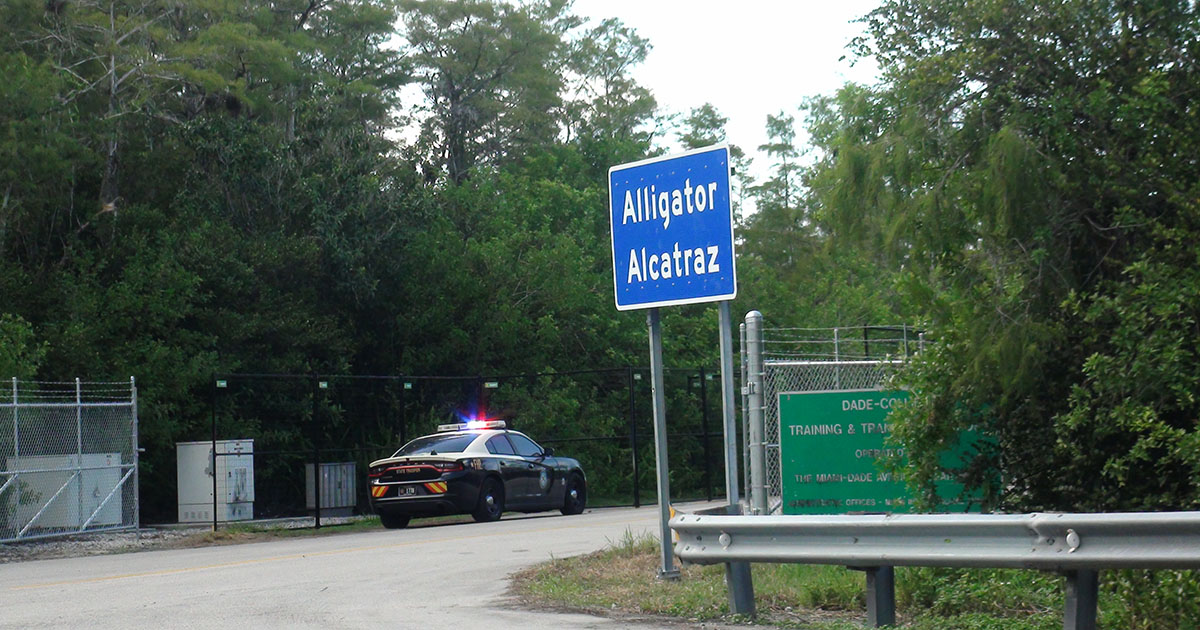

The name was meant to sound tough. “Alligator Alcatraz” – coined by Florida Attorney General James Uthmeier, who boasted at the opening press conference that detained migrants would find “not much waiting for them other than alligators and pythons. Nowhere to go, nowhere to hide.” Less than a year later, the facility is empty, the tents are coming down, and Governor Ron DeSantis stood at the same remote airstrip in the Florida Everglades on June 25, 2026, to announce it was over.
The official story is tidy: a temporary solution that served its purpose, now stepping aside for more permanent federal capacity. The less tidy version involves $1.2 billion in taxpayer money, a stack of federal lawsuits, verified reports of torture, an outraged Indigenous tribe, and a fragile national ecosystem that no one asked about before bulldozers arrived. The DeSantis immigration facility that made international headlines has closed – but the arguments about what it actually was, and what it did, are far from settled.
To understand why this matters beyond Florida politics, you have to go back to how fast the whole thing came together.
Built in Days, Opened With a Fanfare

The facility opened on July 3, 2025, and was the brainchild of DeSantis and Florida Attorney General James Uthmeier, built using state tax money. The detention center of tents and trailers was constructed in a matter of days. It was billed as a 5,000-bed facility, located at an abandoned airfield in the Everglades wetlands – specifically the Dade-Collier Training and Transition Airport in Ochopee, about 50 miles west of Miami, a hastily constructed facility on an abandoned airstrip in the middle of the wetlands, built out of tents and trailers, and surrounded by alligators, pythons, mosquitoes, and swampland, at serious risk of dangerous flooding.
President Donald Trump and then-Homeland Security Secretary Kristi Noem joined DeSantis and Florida state leaders for the facility’s opening on July 1, 2025. At the time, Trump said it “might be as good as the real Alcatraz,” the shuttered maximum-security federal prison off the coast of San Francisco. The symbolism was deliberate. This was immigration enforcement as spectacle – a statement facility designed as much for cameras as for any operational purpose.
The decision to eventually close the facility had been speculated for the past two months, with even DeSantis previously saying he expected it to close soon. “If we shut the lights out tomorrow, we will be able to say it served its purpose,” he said earlier this month during a press conference.
The Official Rationale: Mission Accomplished
DeSantis held a news conference at the facility on Thursday morning and confirmed that the mission was completed and all detainees had been relocated. He made the announcement alongside White House Border Czar Tom Homan and Florida State Board of Immigration Enforcement Executive Director Anthony Coker.
DeSantis’s position was consistent: the facility was always temporary, always designed to fill a gap while the federal government built out permanent detention capacity. “We stepped up because there was a gap, but my hope is that they’ll be able to handle that,” the Republican governor said at the news conference. He pointed to a specific number as the measure of success: 21,000 people deported through the facility. “There is no question this mission has made the state of Florida safer,” he said.
Even with the closure of the facility, Florida continues to play a key role with other detention centers and an increased role in helping with immigration enforcement, White House Border Czar Tom Homan said at Thursday’s news conference. The state’s Deportation Depot in Baker County has processed 10,000 immigrants and will continue to operate. Florida is the only state in America that requires all state agencies to cooperate with federal law enforcement agencies for immigration enforcement.
The immediate trigger for the final closure was the 2026 hurricane season. The season started June 1, prompting Florida officials to move detainees out of the soft-sided facility. Lawyers for the immigrants said their clients suddenly started leaving for other facilities in South Florida, California, Arizona, Louisiana and Texas earlier this month, disappearing for about a week before their attorneys and families were told where they were sent. DeSantis said he expects the center to be fully dismantled in about a week or two.
What It Actually Cost
The $1.2 billion price tag deserves its own paragraph. The decision to close Alligator Alcatraz was due primarily to the escalating cost of operating the facility. The total cost is now estimated to be $1.2 billion. For context, between June and August 2025 alone, the state issued 34 no-bid contracts totaling more than $360 million for the facility, with annual operating costs projected at $450 million – all drawn from public funds. Advocates for immigrants said the closure does nothing to stop the harm to people who spent months in custody while their families suffered. The Florida Immigrant Coalition said the only winners were corporations and contractors who profited millions of dollars as Republicans pushed an immigration emergency that, the coalition argued, does not exist.
That last point has a specific legal context. According to court records, only 1.79% of new cases in fiscal year 2026 sought deportation orders based on any alleged criminal activity of the immigrant. That means the vast majority of immigrants detained or facing deportation do not have a criminal record – a figure that complicates DeSantis’s framing of the facility as a tool for removing dangerous individuals from Florida’s streets.
The Conditions Inside
Since its opening, human rights groups decried unsanitary conditions and torture-like treatment at the facility. The accounts that emerged over eleven months were detailed and consistent across multiple independent investigations.
Immigrants imprisoned at the facility described overflowing toilets leaking into sleeping areas, inadequate access to showers, constant 24-hour lighting, insect infestations, unsafe food and water, and degrading treatment. Some were forced to scoop human waste from clogged toilets with their bare hands because there was not enough water pressure to flush. Reports documented ongoing routine shackling, physical abuse by guards, and prolonged solitary confinement.
A December 2025 report from Amnesty International, which conducted a research mission at the facility in September 2025, went further. Its investigators found that detainees were put in a “box,” described as a 2×2 foot cage-like structure used as punishment, sometimes for hours at a time exposed to the elements with hardly any water, with their hands and feet attached to restraints on the ground. The report concluded that these conditions amounted to torture under the United Nations Convention Against Torture. The facility operated outside federal oversight, without the basic tracking systems used in ICE facilities. That absence of registration or tracking meant detainees could be held incommunicado, with their whereabouts denied to families and attorneys, which the report classified as enforced disappearances.
State and federal officials denied all allegations of torture and inhumane conditions throughout the facility’s operation.
The Legal Fights

The lawsuits started almost immediately. The American Civil Liberties Union, ACLU of Florida, and Americans for Immigrant Justice sued over the facility in July 2025, challenging the lack of access to legal counsel and violations of due process for people held there. A federal court responded by ordering ICE to provide confidential legal calls and to publish information about how attorneys could contact detainees. At the outset of the litigation, the facility operated as a “black hole” for detained immigrants and their attorneys. There was no publicly available information explaining how lawyers could contact clients, arrange visits, or access the facility. Attorneys searching for detained clients encountered dead ends, bounced emails, unanswered calls, and armed checkpoints.
The broader legal concerns went well beyond due process. Federal emergency powers used to build and operate the facility in the first place – invoked without environmental review, without local approval, without public hearings – have become a defining feature of this era of immigration enforcement. The presidential emergency powers used to fast-track its construction have roots that predate the current administration by decades; the legal history behind them is worth understanding in full.
One particularly alarming pattern documented in the ACLU lawsuit involved guards going cell to cell, pressuring detainees to sign voluntary departure orders without access to legal counsel. People with valid claims to remain in the United States, some with court dates already scheduled, were signing these orders without understanding what they were agreeing to. One documented case involved an intellectually disabled detainee who signed what he was told was a request for a blanket. It was a voluntary departure order. He was deported within days.
What the Everglades Lost

The human cost dominated coverage, but the environmental damage was working through the courts in parallel from before the facility even opened. Earthjustice, Friends of the Everglades, and the Center for Biological Diversity filed a lawsuit in June 2025 to enforce the National Environmental Policy Act, which requires federal agencies to evaluate the environmental impacts of major projects before they are approved. The Miccosukee Tribe of Indians of Florida joined the lawsuit to protect tribal rights.
The facility, which sits in the heart of Big Cypress National Preserve, continues to threaten the Everglades with more than 20 acres of new pavement, hazardous waste, diesel generators, heavy equipment, and glaring lights that harm wildlife and Miccosukee tribal villages. Florida panthers have been documented crossing the site. Florida bonneted bats, an endangered species with critical habitat overlapping the Miami-Dade County property, need dark skies to feed – and the blinding lights at the facility remain visible via satellite.
Betty Osceola, an Everglades defender and Miccosukee tribal elder who was denied access to sacred lands and participated in regular interfaith vigils outside the facility, described it as “a blight on the Everglades” since its inception. Osceola’s tribe has a deep and personal connection to the landscape and believes the Miccosukee people are its rightful stewards.
Environmental groups sued over the detention center, saying Florida officials never got the proper permits or did required reviews on its impact. The state and federal governments built the site with no oversight and closed it with no input, but attorneys for the plaintiffs said they would still be held responsible even with the site closed.
Read More: Why you might want to rethink retiring in Florida- 10 reasons retirees leave
What Closing Actually Means
The closure of the DeSantis immigration facility is real – the detainees are gone, the demobilization has begun, and the Dade-Collier airstrip will eventually return to its prior use as a small pilot training airport. Miami-Dade Mayor Daniella Levine Cava’s office reviewed the property and found the facility no longer represents its best long-term use, citing its remote location, limited aviation value, significant maintenance costs, and reduced compatibility with surrounding conservation lands. Her office said they will work with federal and state agencies, tribal governments, and environmental restoration officials to determine the best path for transferring the land.
In a statement, Levine Cava said she had “raised serious concerns about the ‘Alligator Alcatraz’ detention facility because people have been held there in inhumane conditions without meaningful due process, while occupying land alongside one of the world’s most precious natural ecosystems.” She added that once the facility is decommissioned, she intends to pursue permanent protection of those lands for Everglades restoration.
But the lawsuits continue. Environmental groups say the cleanup bill alone could top $40 million. The ACLU and Americans for Immigrant Justice have warned that detainees transferred to other facilities may face the same civil rights violations they experienced at Alligator Alcatraz. Polling found the facility deeply unpopular, with only 35 percent of Floridians approving and 51 percent disapproving – numbers that carry a certain political weight heading into a midterm election cycle.
DeSantis called the facility a success on the numbers – 21,000 deportations, a gap filled, a mission complete. His opponents call it a billion-dollar embarrassment built on a manufactured emergency and run without the oversight the law required. Both sides are still in court. The tents are coming down. The people who were held inside them have been scattered to detention facilities across the country – California, Arizona, Louisiana, Texas – in transfers so sudden that their lawyers didn’t know where they’d gone for nearly a week. That’s not a clean ending. It’s the same story, relocated.
AI Disclaimer: This article was created with the assistance of AI tools and reviewed by a human editor.