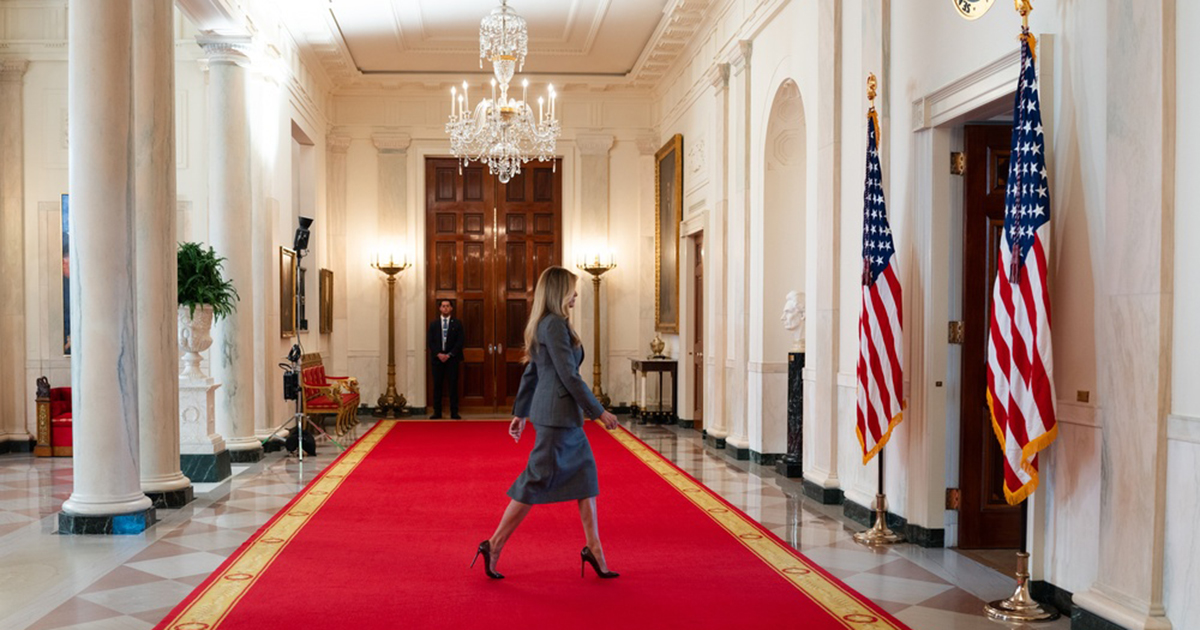

The most powerful address in the world has exactly one first lady, and she did not want Elon Musk sleeping there. That detail, buried in a new book about Donald Trump’s second term, tells you more about the dynamics inside the Melania Trump White House than almost anything that happened in public over the past eighteen months.
Two New York Times reporters, Maggie Haberman and Jonathan Swan, spent roughly two years and a thousand interviews building an account of how Trump’s second presidency actually runs. The result is Regime Change: Inside the Imperial Presidency of Donald Trump, published June 23, 2026. By their telling, the presidency operates on instinct, grievance, and a very short list of people whose opinions actually count. And in at least one case involving a high-profile overnight guest, the first lady’s opinion didn’t make that list.
According to the book, then-DOGE head Elon Musk asked Trump if he could sleep at the White House. Donald Trump agreed. Melania did not. She objected and was overruled. The sleepover happened anyway.
The Lincoln Bedroom, the Sleeping Bag, and the Ice Cream
The SpaceX and Tesla founder went on to spend multiple nights in the Lincoln Bedroom, as Regime Change documents in detail. The Lincoln Bedroom is not a spare room. It’s one of the most historically significant spaces in the building, used since Abraham Lincoln’s presidency and traditionally reserved for distinguished guests. Putting Musk there, over his host’s spouse’s explicit objection, was not a small thing.
Musk himself seemed unbothered by any of it. In May 2025, he told reporters he “sometimes” stayed overnight at the White House, while insisting it was only at the president’s invitation. In Musk’s version of events, Trump had asked where he was staying as the pair were traveling aboard Air Force One. When Musk replied that he didn’t know yet, Trump invited him to the White House and gave him a private tour. Musk said Trump showed him the Lincoln Bedroom and told reporters: “I didn’t request it, to be sure.”
The nights he wasn’t in the Lincoln Bedroom, the picture gets stranger. On other nights Musk stayed with friends, though he also told associates he had taken to using a sleeping bag on the floor of his office in the Eisenhower Building. The Eisenhower Executive Office Building sits directly next to the West Wing and houses much of the administration’s staff. The image of the world’s wealthiest man on a sleeping bag on a government office floor, a few hundred yards from where the first lady had objected to his presence, is one of those details that sounds too strange to have been invented.
During his four-month stint as a special government employee, Musk oversaw numerous layoffs across multiple federal agencies and pushed budget cuts. A major Trump donor in 2024, he had promised to root out bureaucratic waste and save the government $2 trillion – but federal spending actually rose.
She Was Overruled More Than Once
The sleepover dispute was not Melania’s only losing battle inside the Melania Trump White House. Haberman and Swan paint a picture of a first lady who had clear ideas about her home and found them systematically ignored.
The book details how Trump and Melania are the first couple to sleep in separate bedrooms since Richard and Pat Nixon, though Bill and Hillary Clinton slept apart briefly when his affair with Monica Lewinsky became public. Melania occupies the traditional master bedroom of the Executive Residence, Room 219, while Trump sleeps in Room 220, next to the second-floor space known as the Yellow Oval.
Trump’s relationship to his bedroom appears to be an active project. Haberman and Swan write that Trump filled his new solo bedroom with gold objects that had “vanished” from their original location, including some he personally transported in from the corridor. Melania had selected the decor during the president’s first term, but as she spent less time in Washington at the start of his second term, Trump had free rein to rearrange things to his own taste. When staff pointed out that the items being relocated were ones his wife had personally chosen, it made no difference. White House staff would attempt to replace missing items by sending photographs of potential replacements to Melania for approval, a workaround that speaks to how thoroughly she had been sidelined from decisions about her own living space.
The Rose Garden was another front in the same conflict. Melania objected to her husband’s plan to pave over the lawn to recreate a patio space similar to his Mar-a-Lago estate in Florida. The couple’s compromise saw the grass paved over in 2025, but the roses remained intact. Trump acknowledged the tension himself. During a speech on the paved Rose Garden, he said: “This used to be grass. I took a little heat from my wife. She said, ‘Darling, what did you do with my grass?’ I said people got tired of standing in mud.”
The bigger loss came with the East Wing. In October 2025, Trump ordered the demolition of the East Wing – the traditional location of the First Lady’s offices – to make way for a ballroom expansion. Melania Trump lost that fight after raising concerns about the size, location, and construction disruptions. Trump’s team knew, according to the reporting, “that this was not going to make the First Lady happy, but it still went ahead.”
A Book That Made the White House Nervous
The revelations about Melania arrive inside a much larger account of how Trump’s second term operates. The 496-page book covers what Haberman and Swan describe as “a term liberated from every constraint that defined his first.” The breadth of the reporting alarmed the administration before the book even shipped.
Axios reported in June 2026 that top White House officials feared Haberman and Swan had obtained audio recordings of classified Situation Room meetings for the book. Independent recording devices in the Situation Room are forbidden. “We’re afraid some of our most sensitive conversations were being recorded,” an administration source told Axios, adding: “And we have no idea which ones.” The White House has not disputed the verbatim dialogue attributed to its most senior officials that appeared in the book’s excerpts.
Beyond the domestic details, the book includes an account of how Trump decided to take the United States to war with Iran, detailing conversations with advisers and his military leadership about the decision-making process. The war-planning group was kept so tight that Treasury Secretary Scott Bessent and Energy Secretary Chris Wright, the two officials who would need to manage the largest supply disruption in the history of the global oil market, were not in the loop one day before the launch of the war.
The domestic details are no less striking. These include Trump DIYing changes to the Oval Office armed with super glue, and the 80-year-old leaving evidence of his late-night snacking on the ground for White House staff to clean up. Staff monitored trash in Trump’s bedroom after finding he sometimes threw away White House sterling silver utensils along with snack wrappers, potato chip bags, and ice cream cartons.
Musk and Melania Were Not Alone in Their Frustration
Melania’s objection to the Musk sleepovers put her in company she probably didn’t expect. In a December 2025 Vanity Fair profile, White House Chief of Staff Susie Wiles described Musk as “an odd, odd duck” and called him “an avowed ketamine” user. Wiles also said she was initially “aghast” at Musk’s dissolution of USAID, and that “no rational person” could think his process was good. Separately, Treasury Secretary Scott Bessent clashed with Musk in a heated argument over the IRS during Musk’s tenure at DOGE.
The Trump-Musk relationship itself has moved in multiple directions since the DOGE days. Their public feuding, which included a back-and-forth over Musk’s criticism of Trump’s “big, beautiful bill,” erupted in 2025. But Musk indicated in early 2026 that there was some repair work happening when he shared a photo of himself dining with the president and the first lady at Mar-a-Lago. The same first lady who had not wanted him sleeping down the hall.
Read More: Elon Musk Becomes the World’s First Trillionaire After SpaceX’s Historic IPO
What the Silences Tell You

What’s most striking about the Melania picture that emerges from this reporting isn’t any single incident. It’s the accumulation. The decor removed from the spaces she chose. The garden she didn’t want paved. The office wing she didn’t want demolished. The guest she didn’t want in the Lincoln Bedroom. In each case, her preference was registered – sometimes through formal channels, sometimes through the plainly communicated unhappiness of her team – and then set aside.
Melania Trump has never been a first lady who performed her role loudly. Her 2024 memoir, which she wrote herself, was criticized by reviewers for its lack of insight into her marriage with Donald Trump, with one assessment describing writing that “barely grapples with the mysteries of her marriage.” The book you actually read to understand the marriage, apparently, is the one written by two journalists who spent two years talking to everyone around it.
The pattern documented by Haberman and Swan doesn’t tell us what Melania thinks or feels about any of it. What it does tell us is that her preferences, expressed clearly and through proper channels, have not been the deciding factor in much of anything inside that residence. The sleeping bag on the office floor down the hall was Elon Musk’s. The losses on the Rose Garden, the East Wing, and the guest room were hers.
Some partnerships in marriage operate on one person’s vision and the other person’s accommodation. The White House, apparently, is no exception.
AI Disclaimer: This article was created with the assistance of AI tools and reviewed by a human editor.