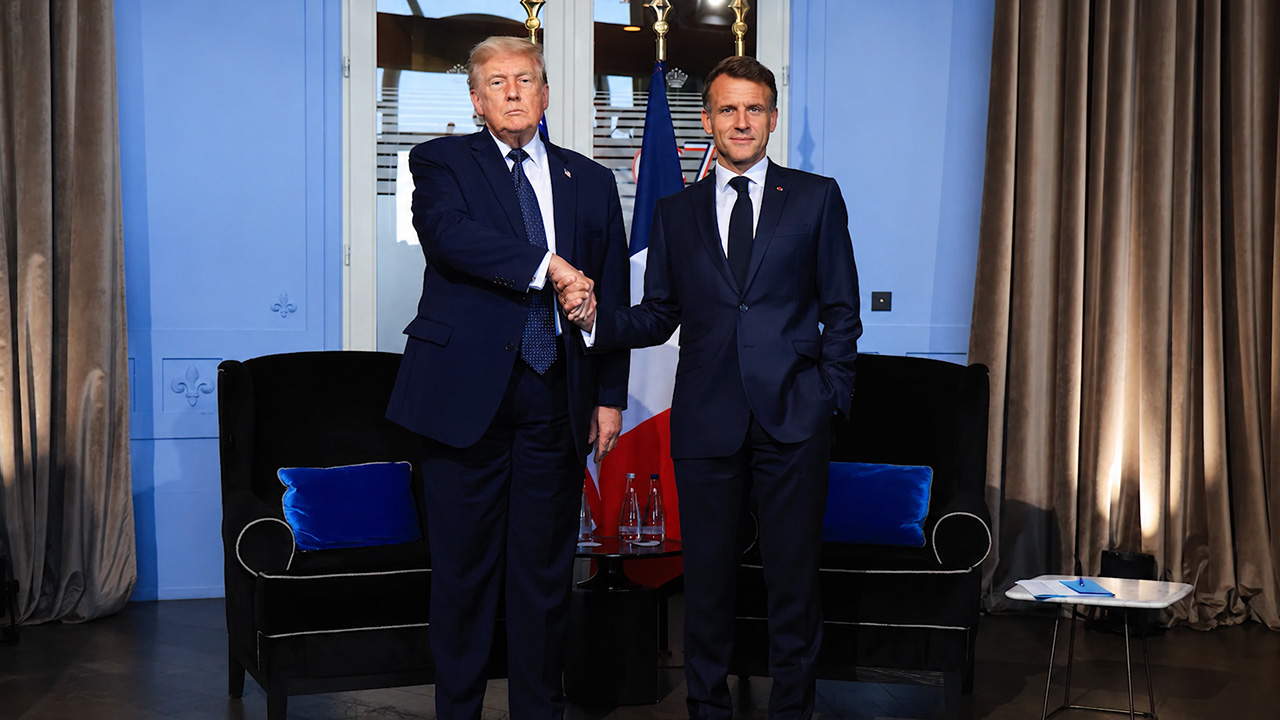
The moment that stood out at the G7 summit in Évian-les-Bains on June 15, 2026, had nothing to do with trade policy or Iran. President Donald Trump arrived to greet French President Emmanuel Macron with what began as a quick and relatively normal handshake between the two leaders. Then things got strange.
Trump gave Brigitte Macron a customary kiss on each cheek as he took her hand – but then didn’t let go. He held onto her hand for about 13 seconds, continuing to shake it while speaking to the couple. Critics quickly noticed what they viewed as Trump putting extra force into his handshake with Brigitte compared to the greeting he gave her husband. The clip spread within hours. By nightfall, it was one of the most-watched moments of the entire summit.
What made the scene doubly strange was the contrast it created. Trump, on his second day of being 80, and his French counterpart awkwardly shook hands as Macron welcomed him to Évian-les-Bains – with the president appearing to barely put any weight into the handshake with the French leader himself, limply taking Macron’s hand into his. Trump had a drowsy look on his face during their meeting. Firm with the wife. Limp with the husband. The internet noticed immediately, and the commentary wrote itself.
The Two Handshakes That Broke the Internet
Trump’s G7 handshakes with the Macrons reignited online debate about his health, after cameras caught him greeting Emmanuel Macron with a visibly weak grip and an oddly angled arm – a moment that stood out partly because it contrasted so sharply with his long-standing reputation for forceful, showy handshakes on the world stage.
The news came after Trump had already become the subject of online commentary for a very different reason: he had been seen appearing to fall asleep during a UFC fight at the White House to mark his 80th birthday. Viewers then turned their attention to his right hand during the Macron meeting, where it was held at what appeared to be a near-vertical angle as he greeted the French president.
Trump held his right hand at an almost vertical angle during the greeting, an unusual posture that immediately raised eyebrows. Sharp-eyed viewers were convinced they could still detect dark bruising across the back of his hand even through the awkward positioning. The White House did not issue a statement specifically about the handshake style, but observers weren’t waiting for one.
Someone online declared, “He’s too scared to do it with Macron. He has to bully his wife.” The tugging was also likened to an orchestrated stunt to substantiate White House claims about Trump’s tender hands.
A Pattern Going Back Nine Years
Trump and Macron’s handshakes have become a running sideshow at international summits over the years. The history between these two men and the art of the grip is long enough to fill a documentary.
Their very first handshake, ahead of a NATO summit in Brussels in May 2017, set the tone for everything that followed. The two men locked hands for so long that knuckles started turning white. The French leader held the shake for a few seconds more. Both men’s jaws seemed to clench. Macron was blunt about what that moment meant. He said his famous white-knuckle handshake showdown with Trump was “a moment of truth,” and told a French Sunday newspaper, “My handshake with him, it wasn’t innocent.”
The length of that 2017 handshake, in which Macron clutched Trump’s hand and the U.S. president tried to get free, ran to a colossal 29 seconds. It became the template for everything that came after.
In June 2018, the presidents met again at the G7 summit and shook hands multiple times, including one particularly firm shake that left the shape of Macron’s thumb imprinted on Trump’s hand. By the time the two reunited for the reopening of Notre-Dame cathedral in December 2024, Trump pulled Macron’s right hand toward his body as the two hugged and gripped each other with clenched fists, shaking firmly back and forth – while friendly, it appeared both men were holding on tight.
At a summit in Egypt in October 2025, marking the peace deal between Israel and Hamas, Trump and Macron clasped hands in an oddly lengthy handshake that lasted around 26 seconds – a shake that began in a traditional form before morphing into an arm-wrestling-type grip part of the way through.
The June 2026 G7 summit in Évian was supposed to be just the latest chapter. Instead it produced two contradictory handshakes in the same afternoon – and a question that nobody at the summit was willing to answer out loud.
Not Just Macron
The Trump handshake has been causing diplomatic whiplash since 2017, and it’s never been exclusively a French problem. Trump’s handshake with Supreme Court Justice Neil Gorsuch drew notice when it appeared like Trump was tugging on the justice’s hand, and his handshake with Canadian Prime Minister Justin Trudeau was thoroughly analyzed, with many opining that Trudeau wasn’t letting himself get pulled into the traditional tug.
Sometimes a lack of a handshake says even more. Trump drew similar fanfare when he declined to shake the hand of German Chancellor Angela Merkel when she visited the White House.
In March 2026, an episode unfolded during a meeting with Paraguayan President Santiago Peña, where Trump attempted his familiar extended clasp. The pair met at the “Shield of the Americas” Summit at Trump’s golf club in Doral, Florida. The moment quickly looked less like a confident greeting and more like a stubborn stalemate, as Peña held his ground and resisted the pull. Trump tried to pull; the leader pulled back. Trump’s smirk at the end appeared to show defeat.
When Trump usually meets world leaders, he typically tries to dominate the handshake, as evidenced by his 14-second handshake with Chinese President Xi Jinping earlier in 2026. That handshake with Xi went viral.
The pattern, played out across nine years and dozens of countries, is consistent enough to have its own grammar. Firm grip, extended duration, a pull toward the body, occasional position jockeying for the dominant hand placement on top. Against some leaders it worked. Against others it didn’t. Against Macron, starting in 2026, it seems to have stopped working altogether – or at least stopped looking like the same thing it used to be.
The Hand Itself
Any discussion of the Trump handshake in 2026 runs directly into the question of his hands’ physical condition, and the White House has been managing that story for months. The White House and Trump attributed bruising that appeared in January 2026 to the president hitting his hand on a table, as well as a daily aspirin regimen.
Trump has, for many months, been seen with bruising on his hands while speaking publicly about the cardiovascular benefits of aspirin – an over-the-counter medication whose side effects can include increased bleeding or bruising. The White House attributed the bruising to the president’s frequent handshaking and use of aspirin.
The explanation for the aspirin came from Trump himself. He told a CNN-reported Wall Street Journal interview, “They say aspirin is good for thinning out the blood, and I don’t want thick blood pouring through my heart. I want nice, thin blood pouring through my heart. Does that make sense?” CNN medical analyst Dr. Jonathan Reiner responded directly to that explanation, saying it “makes no sense” – pointing out that aspirin doesn’t literally thin the blood but reduces the likelihood of clotting, and that 325mg daily increases bleeding risk without increasing the drug’s cardiac benefit.
Trump’s latest handshake awkwardness came at a time when he’s suffered from bruises on the back of his hand, which the White House had initially blamed on “shaking hands all day, every day.” In July 2025, the White House medical unit conducted tests on Trump after noticing mild swelling in his lower legs. Doctors found Trump has chronic venous insufficiency, a condition common in older adults that causes blood to pool in the veins. The White House said at the time that tests found no evidence of deep vein thrombosis or arterial disease.
His right hand is also perpetually bruised, which the 80-year-old president typically tries to cover up with makeup – his hand was covered with makeup just hours before he met with Macron after his birthday bash. The White House has repeatedly asserted his bruising is due to “frequent handshaking,” with Press Secretary Karoline Leavitt claiming Trump is “a man of the people” who “shakes their hands on a daily basis.”
The White House explanation and the camera footage exist in uneasy tension with each other. The explanation says the handshaking causes the bruising. The footage from the G7 shows a handshake that, at least with Emmanuel Macron, barely happened.
What the Body Language Actually Says
For anyone who studies nonverbal communication professionally, the Trump handshake has been a long-running case study. Body language expert Traci Brown and behavioral scientist Abbie Maroño both weighed in on the G7 moment for a HuffPost analysis. Brown’s read was blunt: “It seems like someone stayed up too late. He’s there in body, but that’s it.” She noted that his usual “yank-and-grab” style was almost entirely absent with Macron – “His brand is power and force, and so this is the exact opposite of that.” Maroño described the grip as so passive “it was disrespectful.”
The contrast with Brigitte Macron made it stranger. Trump let his wrist hang downward while Macron did most of the work maintaining the handshake with him – then turned around and held Brigitte’s hand for 13 seconds with visible grip. The difference between the two greetings, within the same sixty-second interaction, is what the cameras caught and what the internet couldn’t stop replaying.
Trump’s sideways positioning during the Macron greeting added another layer. Body language analysts note that when someone angles their body away rather than facing the other person square-on, it typically signals discomfort or a desire to disengage – the opposite of the dominant, squared-up stance Trump usually deploys.
Read More: The Bizarre Fox News Clip That Triggered a Massive Online Conspiracy
When a Handshake Becomes the Story
Heads of state shake hundreds of hands a year. The act is so routine it almost never registers. Since that Brussels tarmac in 2017, though, the Trump handshake has never been incidental. It has always been a statement – something Macron acknowledged explicitly at the time, and something the leaders who have quietly braced themselves against it have understood ever since.
The trouble with using a physical act as a power signal is that the signal shifts the moment the physical act does. The leaders convened in Évian-les-Bains against a backdrop of real tension – strained transatlantic relations, disagreements over Iran, and a Trump-Macron dynamic that analysts had flagged as likely to surface behind closed doors. The handshake wasn’t just backdrop to those tensions. For a lot of people watching, it looked like evidence of something.
The White House’s standard answer – that constant handshaking is wearing the president’s hands down – ran straight into the G7 footage. The handshake with Macron was anything but forceful. The long, firm, tugging grip that has defined their encounters since 2017 was largely absent in the initial greeting. The force went instead to Brigitte. The internet filled in the rest.
Some of these moments are probably less significant than the attention they receive. A president looks tired after a late-night birthday party. His hand angle is off. A grip lasts a few seconds longer than expected with someone’s spouse. Individually, none of it adds up to much. But the Trump handshake has never been treated as just a handshake – not by Macron, who admitted it in 2017, not by the leaders who have braced themselves against it, and not by the cameras that have been trained on it for nearly a decade. The grip has always been the story. What’s new is that the story keeps changing.
AI Disclaimer: This article was created with the assistance of AI tools and reviewed by a human editor.