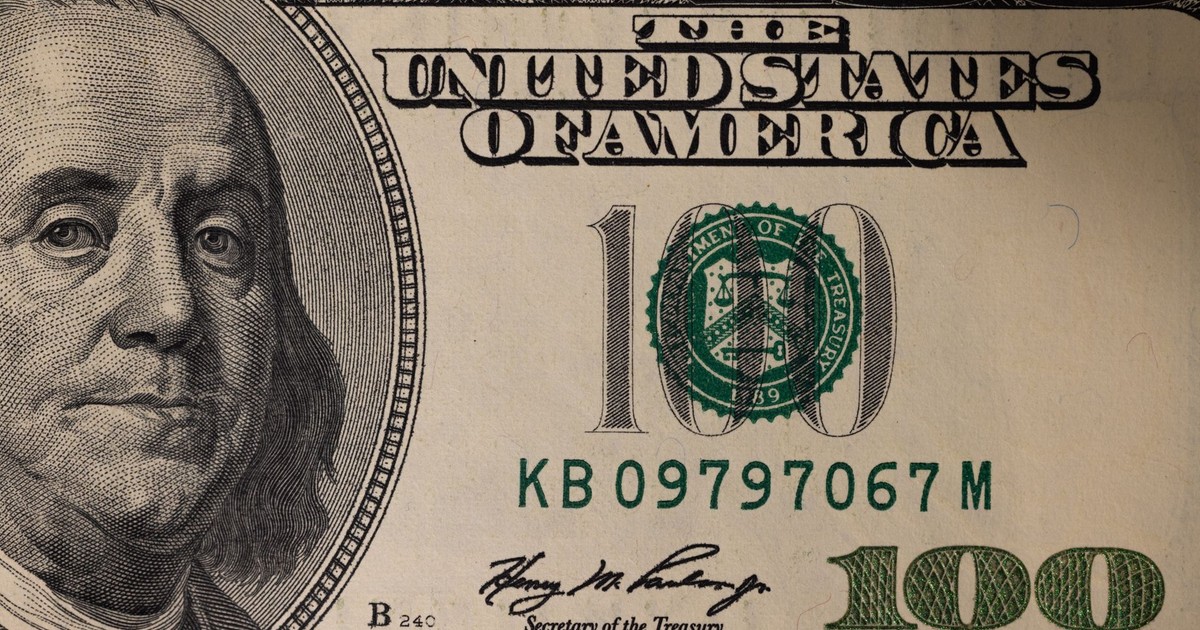

Benjamin Franklin has been on the $100 bill since 1914. The two signatures at the bottom have always belonged to the Treasury secretary and the US Treasurer, the two officials whose job it is to certify the note is real. Neither of those signatures has ever belonged to a sitting president. Until July 3, 2026.
On that Friday afternoon, Donald Trump posted an image to his Truth Social account showing a redesigned $100 bill carrying his signature above Treasury Secretary Scott Bessent’s. The post came months after the Treasury Department announced that, for the first time in history, a sitting president’s signature would be featured on US paper currency. The move has been framed officially as a tribute to America’s 250th birthday. But the bill that landed on the internet that day has a detail that a lot of people found hard to look past: the president’s name, in his own hand, on the money itself.
Not the note’s design, which is otherwise familiar. The implication: who gets to put their name on the national currency, and what it means when someone decides the answer should be “me.”
What Changed on the $100 Bill
The image Trump posted shows the president’s signature above Bessent’s. Previously, the $100 bill featured the signatures of the Treasury secretary and the Treasurer of the United States, not the sitting president. That two-signature arrangement has been standard on Federal Reserve notes for decades. The president’s name appearing nowhere on the bill wasn’t an oversight. It was the default, because no one had ever thought it needed to be otherwise.
According to a March 2026 Treasury announcement, Trump’s signature will appear on future US paper currency along with the Secretary of the Treasury, marking the first time in history for a sitting president. The announcement framed this as an honor tied to the nation’s semiquincentennial, the 250th anniversary of American independence celebrated on July 4, 2026. Bessent was vocal in his support, touting the president’s economic achievements and saying it is “only appropriate” that currency bearing Trump’s signature be issued in honor of the anniversary.
US Treasurer Brandon Beach echoed that language back in March, when the change was first announced. He called Trump “the architect of America’s Golden Age economic revival” and said printing his signature on American currency was “not only appropriate, but also well deserved.” Beach subsequently posted that the new $100 notes would soon be in circulation, though no precise timeline has been confirmed. It typically takes a few weeks between when notes are printed by the Bureau of Engraving and Printing and when the Federal Reserve ships them out.
What the Law Actually Says

The signature change and a portrait are two very different things, and that difference in the law matters here. Under 31 USC 5114, only the portrait of a deceased individual may appear on United States currency and securities. The law says nothing specific about signatures, which is the gap the Trump administration is stepping through. A handwritten name is not a portrait. The statute, read literally, doesn’t prohibit it.
The signature change is entirely separate from a broader push by some in Congress to place Trump’s portrait on a new $250 commemorative bill, an effort that faces a significant legal hurdle because US code states that only the portrait of a deceased individual may appear on American currency. The administration is not claiming a right to put Trump’s face on the note. It’s claiming a right to put his name on it, and the law, as written, does not explicitly close that door. You can reject the decision on political grounds while accepting that the statute doesn’t forbid it. Those are two separate arguments, and conflating them doesn’t help either one.
The historical reasons for the prohibition on living portraits are worth knowing. The tradition goes back to George Washington, who refused to appear on the first US silver dollar, believing that putting a living ruler’s face on the currency was the kind of thing monarchies did. Congress codified that position in 1866, after a Treasury official named Spencer Clark put his own face on a five-cent note by exploiting ambiguous legislative language. The resulting law, sometimes called the Thayer Amendment, explicitly prohibited the use of the image of any living person on United States currency. That prohibition covers portraits. A signature is a different argument, and the administration knows it.
The Push for a $250 Bill
The signature on the Trump $100 bill is already happening. The fight still going on in Congress is bigger. Trump administration officials pushed the office tasked with printing the nation’s money to move forward with designing a commemorative $250 bill featuring Trump’s portrait and signature, should legislation to create the new currency pass, which would mark the first time a living person has appeared on US currency in more than 150 years.
Republican Representative Joe Wilson of South Carolina introduced a bill ordering the Treasury Department to print $250 Federal Reserve notes featuring a portrait of Trump. Bessent has addressed the legal question directly. He acknowledged that his two standing mandates for US currency are that “no living person can be on US currency” and that the currency must say “In God We Trust,” and that proposed legislation currently before Congress would need to change the first requirement for Trump to appear on the $250 bill. The portrait can’t happen yet. The law would need to be rewritten first.
The Treasury Department has insisted that no taxpayer dollars will be used to produce the new bill, noting that the Bureau of Engraving and Printing finances its operations entirely through product sales and billings rather than relying on annual congressional appropriations. Whether that framing holds up to scrutiny is another matter, but it’s the administration’s stated position.
According to ABC News, the Treasury has been actively developing plans for the $250 bill featuring Trump’s portrait and signature ahead of any congressional authorization. Trump’s second term has also seen his name or image placed on items including a commemorative US passport, national parks passes, agency buildings in Washington DC, and special investment accounts for babies.
How the Public Is Taking It

Not well, if the numbers are any guide. An Economist/YouGov poll conducted in April 2026 found that 59 percent of Americans said they either “somewhat disapprove” or “strongly disapprove” of Trump’s signature being added to all US paper currency, while 24 percent said they either “strongly approve” or “somewhat approve.” Another 18 percent were undecided.
The breakdown by party was stark: 92 percent of Democrats, 65 percent of independents, and 20 percent of Republicans were against the signature addition. Even within the Republican coalition, one in five people objected. A majority of Republicans approved overall, 55 percent versus 20 percent opposed, though MAGA Republicans were more unified at 63 percent in favor, while non-MAGA Republicans were split at 35 percent approving and 40 percent opposing.
The currency debate sits inside a broader pattern of public skepticism about Trump’s relationship with government institutions. The signature on a $100 bill is, in one reading, just a signature. In another, it’s a living president’s name on the instrument that Americans use every day to pay for groceries, rent, and gas, and for a significant portion of the public, that’s the part that feels off.
The Deeper Issue the Bill Raises

The tradition against putting living rulers on currency survived for more than 200 years in the United States. It wasn’t bureaucratic inertia. It was a deliberate choice about what the money represented. Currency, in a functioning democracy, is meant to be impersonal. It belongs to the country, not to whoever happens to be running it at the moment. The faces that do appear on American bills, Lincoln, Hamilton, Franklin, Jackson, have been on there long enough that their presence has become architectural. No one pulling out a twenty is making a statement about Andrew Jackson’s politics. The bill just exists.
A sitting president’s signature changes that. Every $100 bill printed from this point forward becomes, in a small but real way, a document associated with a specific political moment. That’s what makes the image Trump posted feel different from a reprint or a design refresh. It’s not that the money looks dramatically different. It’s that the thing the money says about itself has changed.
The $250 portrait bill, if it ever passes, would be a more dramatic break still. The Citizens Coinage Advisory Committee, which advises on coin designs, declined to weigh in on related Trump coin proposals earlier in 2026, with its acting chair warning that only nations “ruled by kings or dictators” display the image of their sitting ruler on the coins of the realm. That’s a strong statement from an official advisory body, and it reflects a real tension, not just a partisan one, about what these symbols are supposed to mean.
Read More: Why ‘Distrusting’ Federal Judges Are Demanding Everything from Trump in Writing
What Happens Next

The signature is legal. The administration found a gap in the statute and walked through it. If you believe the law should be followed as written rather than as intended, that’s where the argument ends. The signature is on the bill, the bills are going into circulation, and barring an unforeseen legal challenge with actual standing, that’s that.
But legality and wisdom aren’t the same conversation. The reason most democracies avoid having their current leaders’ names on the money isn’t because a law prevents it. It’s because the norm was never supposed to need a law. George Washington understood that without anyone having to write it down. The Thayer Amendment of 1866 had to make the point explicit only because someone tested the assumption and no one had thought to close the door in advance. That’s how norms work until they don’t: invisible until someone decides they aren’t binding anymore.
The $100 bill with Trump’s signature is already printed. The $250 bill with his portrait is still pending legislation. Congress sitting on that bill isn’t just a procedural delay. It’s a live question about whether enough people in the chamber think a meaningful line still exists, or whether the answer is that the line was always just a tradition waiting to be walked past.
AI Disclaimer: This article was created with the assistance of AI tools and reviewed by a human editor.