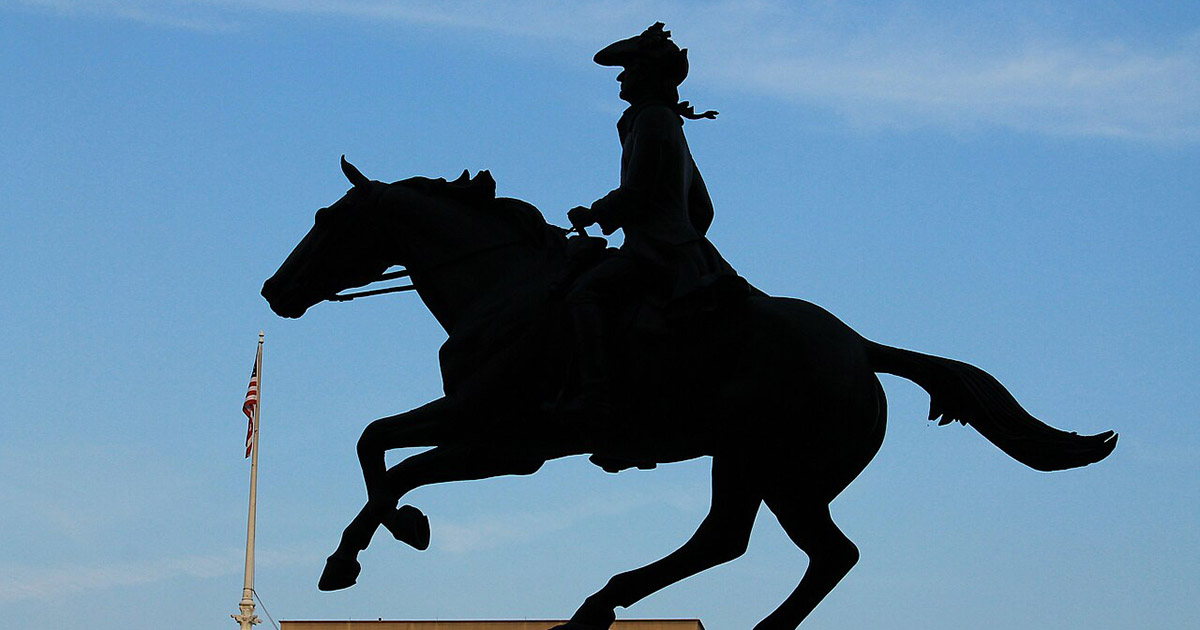

On the night before America’s 250th birthday, President Trump posted on Truth Social urging every American to visit Freedom Plaza in Washington, D.C. The statue he was pointing them toward is an equestrian monument of Caesar Rodney, a signer of the Declaration of Independence who, according to Delaware heritage commission chairman Dick Carter, inherited a farm where he enslaved as many as 200 people. That combination – the midnight rider who tipped a nation toward independence, and the man who held hundreds of people in bondage – is what makes this one of the most contested installations in the lead-up to the nation’s semiquincentennial.
Rodney isn’t a household name. He didn’t have the oratorical fire of John Adams or the literary reputation of Thomas Jefferson. He was a working legislator, a military officer, a man who paid for troops’ supplies out of his own pocket when Congress fell short. And he had a facial cancer so disfiguring that he spent most of his public life wearing a green scarf over half his face, which may explain why almost no portraits of him survive. Most Americans learned his name, if at all, from the 1999 Delaware State Quarter, which bears his image on horseback.
What finally put him back in the public conversation wasn’t a history book. It was a political decision, a storage facility in New Jersey, and an executive order.
Who Was Caesar Rodney?
Rodney’s defining moment came on July 1, 1776, when he learned that his vote was required to break Delaware’s deadlock in the Continental Congress and grant unanimity to Richard Henry Lee’s resolution for independence. Despite suffering from severe asthma and a disfiguring facial cancer, Rodney mounted his horse and galloped 18 hours from Dover, Delaware, to Philadelphia, Pennsylvania, in the dead of night and through a raging storm. He arrived at Independence Hall on July 2, where he cast his vote and secured the nation’s independence.
One reason most people don’t know his name could have to do with his face. Rodney suffered from a facial deformity, likely caused by cancer, that he obscured with a green scarf or handkerchief. This may explain why almost no surviving portraits of him exist, which left him more obscure than other signers. Rather than a fiery orator, Rodney worked steadily on the ground for the cause of independence, held countless public offices, served as Brigadier General of the Delaware Militia, and often paid for troop supplies from his own pocket when Congress failed to provide them.
The question of how many people Rodney enslaved is itself disputed. Dick Carter, chairman of Delaware’s Heritage Commission, previously told The New York Times that when Rodney was 17, he inherited his father’s 849-acre farm, which had as many as 200 slaves. A separate research report commissioned by former Wilmington mayor Mike Purzycki and obtained by Spotlight Delaware estimates the number at closer to 26, reflecting how contested the historical record actually is. As a legislator in 1766, Rodney participated in efforts with the Delaware General Assembly to restrict the importation of enslaved people into the colony. The bill didn’t abolish slavery outright, but it was an early effort to limit its expansion. He also directed in his will that the people he enslaved should be freed after his death. His ownership of hundreds of people and his occasional resistance to slavery’s further spread sat inside the same life, without resolving each other.
In 1976, Delaware issued a postage stamp commemorating Rodney to celebrate the bicentennial, and the Delaware Bicentennial Commission published an entire history of his life, proclaiming him “Delaware’s hero for all times and all seasons.” For most of the 20th century, his ownership of enslaved people was not part of the public story told about him.
The Statue, Its Removal, and the Long Road Back
The statue, which depicts Rodney on a horse, was first erected in Wilmington, Delaware, on Independence Day in 1923, though it was taken down in 2020 amid a racial reckoning after the police killing of George Floyd because Rodney owned hundreds of enslaved people, according to historians.
The Wilmington city government removed the Rodney statue alongside a statue of Christopher Columbus. In a statement at the time, Wilmington’s mayor Mike Purzycki said the statues would be “removed and stored so there can be an overdue discussion about the public display of historical figures and events.” The statues were removed less than three weeks after Floyd was killed by police in Minneapolis, which prompted the removal of statues of figures associated with racial injustice, slavery, or the Confederacy across the country.
The promised discussion largely did not happen. When asked by Spotlight Delaware, Wilmington city and state officials could not provide specific examples of any formal discussions about Rodney that had taken place. The statue spent the intervening years in storage in Swedesboro, New Jersey.
Trump criticized the statue’s removal in 2020, saying in a proclamation on Rodney’s birthday that his statue was removed as part of a “radical purge of America’s founding generation,” saying the memory of Rodney “is at risk of being erased forever.”
US monuments and their contested histories have long been tied to political moments, and the Rodney case is no exception. The National Capital Planning Commission approved preliminary and final site development plans for the temporary Rodney statue placement on April 2, 2026, authorizing the NPS to display it for a period not to exceed six months. The statue itself is on loan from the State of Delaware to the NPS.
“Restoring Truth and Sanity”: The Executive Order Behind It
Executive Order 14253, titled “Restoring Truth and Sanity to American History,” was signed by Donald Trump on March 31, 2025. The statue was installed in Washington to celebrate the 250th anniversary of the United States, with Interior Secretary Doug Burgum saying President Donald Trump is “committed to celebrating and acknowledging the full breadth of our nation’s history.”
During his second term, Trump has taken several steps to restore what he calls “truth and sanity” to American history by removing references that frame the nation’s past as “inherently racist, sexist, oppressive, or otherwise irredeemably flawed,” including removing references to slavery from federal sites. The White House executive order directs the Secretary of the Interior to restore federal parks, monuments, memorials, statues, markers, or similar properties that have been improperly removed or changed in the last five years. The Rodney statue, brought out of storage and installed at Freedom Plaza by National Park Service workers, was a direct product of that order.
The reinstallation follows the return of a Christopher Columbus statue to White House grounds in March 2026, and a Confederate General Albert Pike monument in 2025. The Trump administration also removed content related to Native Americans at Grand Teton National Park, Hubbell Trading Post National Historic Site, and Little Bighorn Battlefield National Monument; related to transgender activists at Stonewall National Monument; and related to climate change at Glacier National Park and other sites. A coalition led by the National Parks Conservation Association filed suit against the Department of the Interior, arguing the actions violated the Administrative Procedure Act. In June 2026, a federal court issued a preliminary injunction ordering the administration to restore signs and exhibits at national parks covering topics including slavery, climate change, and Indigenous history.
What the Exhibition Actually Contains
To honor the heroes and martyrs of the Revolution during the 250th year of American independence, the Trump Administration announced the installation of “Spirit of ’76 at Freedom Plaza,” a temporary statuary exhibition in Washington, D.C. Among the installations is a 23-foot-tall bronze statue titled “Spirit of Liberty,” representing the American ideals of freedom, self-government, and civic responsibility that animated the Revolution.
The other 12 statues depict Revolutionary War soldiers: Caesar Glover, Jack Sisson, James Caldwell, James Lafayette, John Peter Muhlenberg, Joseph Warren, Jude Hall, Naphtali Daggett, Peter Salem, Salem Poor, Samuel Whittemore, and Simon Knowles. Samuel Whittemore, for instance, faced British troops at 78 years old during the Battles of Lexington and Concord; John Peter Gabriel Muhlenberg was a Lutheran minister-turned-soldier later elected to the first Congress; and Simon Knowles enlisted in the Continental Army at 15. The installation also includes formerly enslaved African Americans who served during the war, among them James Armistead Lafayette, a double agent who gathered intelligence for General Washington, and Jack Sisson, who joined a nighttime raid to capture a British general.
Trump’s Truth Social post noted that the Prison Ship Martyrs relief honors “The nearly 12,000 Americans who lost their lives aboard British ships in conditions of unimaginable deprivation, squalor, and disease.” Trump added that “more Americans died on these prison ships than in all of the War’s battles combined.”
The Debate That Hasn’t Settled
Six years after the Rodney statue was taken down in Wilmington, Delawareans still disagree sharply about what should be done with it. As the statue’s loan period runs out, state leaders remain unsure how to reckon with Rodney’s legacy as a slaveholder.
Dick Carter told Spotlight Delaware that Rodney’s view of slavery was “sufficiently complex,” but that he does not believe Rodney was “a strong supporter of the institution of slavery.”
Former Wilmington mayor Mike Purzycki, who ordered the original removal in 2020, put it this way in 2026: “We cannot erase history, as painful as it may be, but we can certainly discuss history with each other and determine together what we value and what we feel is appropriate to memorialize.”
The National Parks Conservation Association described the administration’s broader effort to reshape park narratives as historical “erasure and censure.” And in a state where about one in four residents is Black, some are skeptical that substantive conversations about Rodney’s slave-owning past ever actually happened. “I don’t think the people’s voice has changed because conditions haven’t changed, history hasn’t changed,” said Hanifa Shabazz, who was the Wilmington City Council president when the statue was removed in 2020.
What to Do With All of This
The Trump administration renovated the plaza in preparation for this week’s celebrations of America’s 250th birthday, completing the initiative as part of Trump’s “Making D.C. Safe and Beautiful” initiative, driven by a March 2025 executive order to rehabilitate the District’s infrastructure. The Rodney statue sits at the center of that project, temporarily, on loan, with no settled plan for where it goes next.
Caesar Rodney rode through a thunderstorm, sick and half-blind, to cast a vote that tipped the colonies toward independence. He also held more than 200 people in bondage on a Delaware plantation for most of his adult life. Both of those things happened. Neither cancels the other out. The argument the country keeps having isn’t really about a bronze rider on Pennsylvania Avenue. It’s about which facts get to stand in the town square and which get filed back into storage. That argument predates this installation by decades. What the slave owner statue Trump celebrated this Fourth of July makes vivid is that it hasn’t moved much – the statue went into a storage facility in 2020, came back out in 2026, and the conversation that was promised in between never really happened. When the loan period expires and the equestrian figure is packed up and shipped back to Delaware, it will still be waiting for one.